Showing posts with label YA. Show all posts

Wednesday, January 13, 2016

Review: IT by Stephen King

Howdy strangers! I think I've decided to begin updating this blog again, tentatively.  I think I'm going to mostly limit my posts just to reviews for a while and see how that goes. :)

So, to kick things off with a bang, here's one of my reviews of IT, by Stephen King. I recently re-read this for my NJ Stephen King bookclub, but this is the review that I had written during my last re-read - the one previous to this readthrough. However, I feel that it's the better review so I offer it up here instead. Enjoy!

When I mentioned to a friend that I was re-reading IT, he replied with "Ehh, It's just Stand By Me with a monster. It's overrated." It should be noted that this friend is a movie person (if that wasn't apparent by his use of the movie's title, and not the story's title "The Body"), and I am a book person. It's like we're speaking different languages when we talk about King, because his books, in my personal opinion and with a few exceptions, do not good adaptations make. And since my friend is likely basing his comment on the movie, well... then we're talking about two very different things.

There are similarities between The Body/Stand By Me and IT - each has a group of kids inspired into action on behalf of a dead kid, and there's a bullying theme, as well as a main character that grows up to be a writer. Though I'd argue that these themes are not necessarily uncommon in King's writing in general. Writing about kids is something that King does remarkably well, especially kids who aren't necessarily strong or popular or conventionally "normal". He writes outcasts and kids who are different in one way or another, and where there are outcasts, there are bullies.

But IT is more than just a story about some kids who fight a monster. It's a story of finding the people who complete you, your Ka-tet, if you will. It's a story of bravery and imagination and belief and sacrifice and resilience, of the loss of childhood's innocence, of the necessity at times to recapture the essence of childhood in adulthood.

And IT's about a monster. What the monster is doesn't actually matter. It's like a boggart - it will be what you fear. The monster feeds on pure emotions, fear and chaos and anger and pain, and uses those things to create more. It's influence is a part of Derry, and Derry itself is monstrous in its indifference.

There are many little stories related in Mike Hanlon's interludes about how Derry residents participated in (or sat by and watched, or just ignored) horrible events... beatings, arson, murders, child abuse. The adults in Derry are too far gone in their Grown Up Minds to imagine that there's a source behind this mass violence and indifference... and so it's up to some children to stop it.

I loved watching these kids come together to form the Loser's Club. Honestly, it was a little heartbreaking for me at the same time, because I would have gladly been friends with every one of them, and it hurt me to see them so alone before they found each other. It hurt me to see Ben exclude himself automatically, on the assumption that the fat boy won't be wanted, in an attempt to prevent his own hurt in being excluded by others. It hurt me to see Bill's parents so horribly, selfishly excluding him from their grief and love and lives. They push him away at every turn, never once thinking that he might be hurting as well, never once thinking that he might be blaming himself or need help or support or just his parents. It hurt me to see Mike hurt and hated for simply being black. And Stan for being Jewish. And to see Eddie so cruelly limited and kept apart by his mother whose idea of love is wrapping the poor kid in bubble-wrap and never letting him experience anything at all. And Beverly, whose father's "worrying" leaves her black and blue... And Richie whose mouth runs away from him and gets him into trouble.

There was a bit, toward the end of the book, when Stuttering Bill is standing against IT, that almost brought me to tears despite it being a simple throwaway line in the middle of a dozen empowering realizations: "[...]no more Losers, no more cowering in a hole in the ground and calling it a clubhouse". This was cushioned on each side with powerful emotional images, but THIS line stood out to me, because even though it was just a hole in the ground that they called a clubhouse, the fact that they were together to inhabit it actually made it one, and I was so proud of them for just the simple act of friendship and inclusion that made the place special and safe for them.

And so it hurt me again when their friendship was a sacrifice. It just struck me as so unfair that these 7 kids who found comfort and safety with each other were not able to keep their memories of each other. That in itself is monstrous to me, because the friendship had meaning to them, even if they couldn't remember what they did with it, and for that to be taken was cruel. But IT, and life, I guess, just takes and takes.

I really liked the way that this was written, as well. How the past and the present wound together toward a central point of impact, and the duality of the story, rather than being hard to follow, was perfectly done and made the story. I loved learning about the Losers' childhood experiences as their adult versions' memories returned in increments. I liked seeing how the characters ended up, and how their lives were influenced by their childhood experiences - both positively and negatively.

I particularly respected Mike for his role as the one to man the lighthouse. Big Bill might be the leader, the one galvanized into action against the monster who murdered his brother, but Mike stayed and remembered and watched. And that takes a huge amount of courage in light of what he knew they were up against, and especially on faith that his now adult friends who have forgotten everything about IT will return to help him fight it again. What if they'd just said "Mike? Mike who? Got the wrong number, buddy." and hung up on him. Would he have tried to beat IT on his own? I think he'd have tried, because he alone knew that it would just keep killing kids, cycle after cycle, and that it meant to spread. I don't think that he could have lived with himself if he didn't do something, even if his effort was for nothing.

I also really liked seeing a lot of the references to the Dark Tower series (though they may actually be IT referenced in the Dark Tower books), and some other books as well. It took me a little time to place some of them, like the sunflowers at the Neibolt Street house saying "Our boy?", and I feel like there are still others that I didn't recognize, but it was fun to stumble over these little Easter Eggs.

I did find a few things a bit disappointing, though. I would have liked for there to have been more closure with Tom. I feel like he got off incredibly easily. And I thought that it was a little implausible that the spreading I mentioned would have taken as long as it did. Based on Richie and Mike's vision of IT's pre-historic arrival to the Derry valley, what took so long?

But overall, I loved the book this time around - much more than the first time I read it. I think that the format had a lot to do with that. Steven Weber read the audiobook for this one, and it was fantastic. His reading of IT, the giggle, the gurgling chuckle, the evil good humor fading into menace, and then to a towering rage were all enough to give me goosebumps. His reading of Tom and Bev's father were fantastic as well. He did the voices, but in a subtle way that felt right and not cartoonish or over the top (except when that was called for).

This is a book about children and a thing that lives in the sewers, so there were of course a fair few examples of toilet humor, but if you dig just the tiniest bit, there's a powerful story underneath. And I'm quite happy to say that I wholeheartedly recommend it.


Tuesday, April 9, 2013

Review: Romeo & Juliet by William Shakespeare ★★★

Romeo & Juliet; Or: How Verona High Society Was Devastated Due To Two Kids Who Couldn't Keep It In Their Pants for 24 Hours.

This story is only a tragedy in the sense that, through their stupidity and selfishness, Romeo & Juliet caused others to suffer.

When we meet Romeo, he's in the throes of grief over Rosalind, who he is "in love" with, but who is not interested in him. Oh, he's in a right tizzy over her. The sun shines out her ass and all that, and the world is just a pit of despair without her in his arms, yada yada yada.

Then, OH HAPPY COINCIDENCE, he learns that she'll be at the Capulets' place for a party, so he can go stare creepily at her for a while, and just be in her presence. (Wonder if they had restraining orders back then?) Anyway, while at the party, Romeo blinks and forgets Rosalind completely, because pretty girl! And... is that...? Why yes. That IS the sun shining out of her ass. Someone must have just misplaced their flashlight at Rosalind's rear, because now that he's seen the true sun, there is OBVIOUSLY no comparison in the brilliance of the light.

We're told in the beginning of the story that Montague and Capulet have this feud thing going on. I dunno why, they just do. Makes for a convenient conflict. Tybalt, of Clan Capulet, recognizes Romeo, and thinks he's there to start shit. Remember - feud. So, he makes to fight him, but is shouted down... so he just files it away for future reference. AIN'T NO MONTAGUE GON' COME UP IN DIS CRIB, YO!

Romeo gets all kissy with Juliet. Juliet gets all swoony (it was her first kiss, being all of almost-14 and all), and within a few hours they are engaged. The next day they are married.

Taking things slow. As a lovely wedding gift, Romeo kills Juliet's cousin Tybalt. Well, I mean, Tybalt started it! *stamps foot* He TOTALLY killed Mercutio FIRST! DANG! And so he's banished from Verona.

Verona Death Count: 2

Juliet loses her shit.
Romeo loses her shit. (That's not a typo. Even Friar Lawrence calls Romeo out for crying like a little bitch.)

I would like to take a moment right now to talk about Juliet's moment of losing her shit. Because it is just a moment. Her nurse, who goodness knows needs to be slapped at the best of times, can't be trusted to relay a message accurately, and essentially mindfucks Juliet into thinking for a goodish chunk of time that it's Romeo who is dead. Understandably, Juliet is distraught at the thought that her boyfriend of 12 hours/husband of 3 hours is dead, and she didn't even give up her maidenhead yet (not making this up... she literally laments the fact that he'd not taken her to bed yet)... So, when Nurse FINALLY sets her straight that her boyfriend isn't the murdered but the murderer... Juliet is relieved, happy, and sees this as a comfort.

She sees the murder of her lifelong cousin at the hands of a dude she's known for 12 hours and who previously was a sworn enemy... a comfort.

And she didn't even know if the sex was good yet. O_o

Anyway... So, like... They meet up that night, Juliet finally finds out how the sex is (apparently good enough - WHEW!) and in the morning, Romeo leaves town (banished), and Juliet's kindhearted father promises her to Paris (who I am sure is a nice man, but apparently he ain't no Romeo) and when Juliet refuses, he casts her out. Well, he leaves the option for her to be uncast her out if she agrees to marry Paris. He's a good dad. So accommodating and caring.

She demands Friar Lawrence to help her, so he gives her a potion to allow her to fake her death. She lies to Mummy and Daddy that she'll marry Paris, and then fake-offs herself. Much sadness ensues. The Friar tries to tell Romeo of this plan, but his letter was waylaid, and he found out about Juliet's death through another messenger who didn't know it wasn't real, and he makes haste back to Fair Verona to real-off himself to spend eternity with his wife. Of two days, if my count is right at this point.

Apparently Paris also had the thought of going to visit Juliet, and he meets Romeo, they fight, and Paris dies.

Verona Death Count: 3

Romeo offs himself.
Juliet offs herself.

Verona Death Count: 4 & 5

The parents show up with the prince, who after about 5 minutes' investigation into the events, basically says "See what this stupid feud did? Everyone loses."

So, unless I missed someone in my accounting, Romeo and Juliet caused 2 1/2 deaths per day of their marriage. Could you imagine the state of Verona had they NOT both killed themselves out of angst-ridden lust?

The moral of this story: Just have sex and get it out of your system.


View all my reviews

Saturday, March 2, 2013

Review: The Fault In Our Stars by John Green ★★★

The Fault in Our Stars3.5 stars
Ok, so a little background, just to get a base point for some of my reactions to this book. In late 2010, I read Green's "Looking For Alaska". I ended up liking it more than I thought that I would, but for a long time I'd avoided it based on incorrect preconceived notions regarding what the book was about. It wasn't until I'd watched some of John and Hank Green's Vlogbrothers videos that I decided to go for it. And that made a difference. I could see John in the story - in the quirky intelligent teen characters, in the irreverence, and I liked it. After that, I bought "An Abundance of Katherines" & "Paper Towns", but I haven't read anything but their synopses yet.

So, flash-forward to present day. "The Fault In Our Stars" is chosen to be read among friends, and so I read it. And immediately, I'm struck again by the quirky intelligent teen characters, and the irreverence... But now, it's not so different, because now it seems like a pattern. A style. And that makes it less meaningful. When everyone is profoundly quirky and intelligent, it begins to seem a little trite.

So here again we have quirky intelligent characters, including a host of 16 year olds with ridiculously sophisticated vocabularies, and including an "extremely sophisticated twenty-five-year-old British socialite stuck inside a sixteen-year-old body in Indianapolis". These are midwest teenagers who sound like they're members of the Intelligentsia. Everything is profound and has "metaphorical resonance". It just didn't feel realistic to me.

Case in point: At one point there's correspondence with an author of a book that the main characters found profound, and I had a hard time differentiating between the voice of the Profound Author and the teens.

That shouldn't be the case. Ever. When one of the teens mentioned rhetorically whether the other thought they'd made up the Profound Author's letter, whether it sounded like something they'd come up with, I thought, "Yes!"

It's just too much for EVERYONE in these stories to be so quirky. Where are the average teens who just hang out with each other and don't use $10 words to say hi to each other? It was just unrealistic for me, especially in a book trying desperately to show that kids with cancer are just normal kids who shouldn't be treated deferentially just because they are sick. The problem here is that these weren't normal kids. These were extraordinary ones. Like everyone else. *sigh*

It took about half the book for this annoyance to peter out. It was like, at this point, the quirkiness and $10 conversations took a backseat to the story, finally. And that's when I really started to love it. Coincidence? I think not. Extraordinary characters are great and all, when, as a friend put it, they have "an ordinary background to shine against". I couldn't agree more.

I was far more affected and heartbroken by the simple, no-nonsense way that Hazel talked about her parents and how they were coping (or failing to cope) with her cancer prognosis than by her constant multi-syllabic conversations about the metaphorically resonant quality of... whatever.

There was a line near the end of the book that kind of summed this up perfectly:
"He wasn't perfect or anything. He wasn't your fairy-tale Prince Charming or whatever. He tried to be like that sometimes, but I liked him best when that stuff fell away."
I loved all the bits of this book that were in between all of the uber-profound stuff. The bits about loving and losing in terms of how much both hurt in stark terms of pure aching. Fancy words are fancy, but sometimes the beauty is in simplicity. When all the pretense fell away, and it was just two people wanting to spend as much time as they had left together, it became the story it always should have been.

This ended up being a moving and heartbreaking book, but I think it would have been a much better one had it been written more simply.

View all my reviews

Monday, December 31, 2012

Review: Anna Dressed In Blood by Kendare Blake ★★★

Anna Dressed in Blood (Anna, #1)Wow. I just realized that I added this book to Mount To-Read exactly one year ago today. That's pretty strange, isn't it? I mean, I picked the book up yesterday on a whim, thinking that it would be light, quick reading to squeeze in before the new year. I wasn't looking for any weird cosmic alignments or anything... but it is kind of cool.

As was this book. I really enjoyed it. It was different, very different, than what I expected, but not in a bad way. Well, maybe not ALL bad, because I do have a few *cough* teensy weensy gripes about it.

But first, the things I DID like.

- I really liked the realistic teenager tone of the story. I liked how there were some f-bombs, and how Cas skipped school (albeit for really selfish reasons like "work" and stuff), and how the characters were all relateable. I liked how the usual student tropes both did and did not fall into their usual lines of "Big Dumb Jock" type, or "Most Popular Homecoming Queen Bitch" type, or "Outcast" type. I liked reading about these characters, even the ones I didn't like, and I am excited that this is the beginning of a series. I want to see more of them.

- I really liked that it was a bit horrifying. To be honest, I had kind of pegged this book, pre-read, as that "light, quick" read (as I mentioned before). I thought it would be a little cartoony, may be a little funny at times, but not something I expected to be in any way horrifying. And I don't mean it was scary, although there were some bits that could have been, but I mean more of a "Oh crap, that's not good" kind of horrifying. I liked that it wasn't cartoony or funny (though again there were moments of levity), and I liked that the method of the deaths we're privy to aren't glossed over. We see them as Cas sees them... or as he'd rather not.

- I liked the way that the "Ghost Whisperer" concept was made into something that didn't make me fall asleep and drool all over my nook. I mean, no offense to Jennifer Love Hewitt or anything. I know she's got a lot of loyal (male) fans (fanatics) who watch every episode of her show (hoping for cleavage... COME ON!), but I just can't. I think I've seen one episode and I was bored. BORED. This book though, was not boring. This is no Ghost Whisperer, though Cas does help restless, violent spirits go... somewhere... by murdering them... again. SLICED AND DICED! I like it.

It was gritty and interesting and different. I liked how the practitioners that Cas gets to help him (witches), were portrayed and the way that the rituals and spells were done was different from what I've seen before, though admittedly, that's not all that much. I liked the twist near the end, though the resolution did kind of do a little "fade to black" thing. We're left to assume the outcome based on the set of details, but still hope...

So now we come to the stuff that had me griping. Two things, mainly. OK three things. Tops. Two gripes and a rant.

#1 - The action scenes were a little sketchy and hard to follow for my taste. I like to visualize fight scenes in my mind, and these were hard to see, as they didn't always make sense linearly.

#2 - I don't understand how normal people don't believe in ghosts if they are apparently able to see them all the time without trouble. I can understand Cas's ability to see them, and I can understand the witches being able to, but the Normals, the students with no special abilities at all can also see them (at least 3 different ghosts). Maybe they've all "manifested" as visible to everyone, but I would have liked some sort of explanation here. Either that they HAVE to have manifested even for Cas to see them (which seems likely since Tybalt was a kind of ghost detector), or that proximity to Cas or witches allows others to see ghosts too, or something.

#3 - The Insta-Connection. I was hoping that the connection that drew Cas to Anna would be explained, and it may still be later on in the series, but as of right now, I don't get it. And honestly, that cheapens the story to me.

It would have been a better, stronger story, in my opinion, if Cas was less emotional about Anna, and rather than falling in love with her, he freed her and used her as an ally... maybe working up to something more later, after we get to know them and their characters and situations better. Or not, even. But falling in love with a ghost is hard to believe, despite my suspension of disbelief with the rest of the story, and given that I don't like insta-love (under any euphemism) in the first place is just... kind of disappointing.

I really don't understand why books written for teens and young adults rely so heavily on instant connections and immediate love. I was a teen once, and yeah, I had crushes, and boyfriends, doodled sickening little hearts with initials in them on the margins of my papers (don't tell anyone), and thought that THIS GUY was THE ONE, but I never once felt a bone-deep, undeniable, magnetic connection with anyone. Ever. No matter how strong my feelings were. So I don't get why this unrealistic trait is repeated in book after book after book. It's really starting to turn me off of reading YA. I'm so tired of it. I cannot wait for this trend to be ooooovvvveeeerrrrr.

Please, authors, PLEASE. Stop this. Write realistic relationships!!! I want to read them. Not soulmates or instant love that requires no effort except against outside influences trying to break it up. That's incredibly boring to me, and I'm more than ready for something different!

But still... I DID enjoy the story overall, and I WILL continue the series to see where things go. I'd be interested in the character development of some of the characters, and in seeing more of Cas's world... and possibly others.

Monday, April 16, 2012

Author Interview: Jolene Perry, Author of Night Sky

After losing Sarah, the friend he’s loved, to some other guy, Jameson meets Sky. Her Native American roots, fluid movements, and need for brutal honesty become addictive fast. This is good. Jameson needs distraction – his dad leaves for another woman, his mom’s walking around like a zombie, and Sarah’s new boyfriend can’t keep his hands off of her.

As he spends time with Sky and learns about her village, her totems, and her friends with drums - she's way more than distraction. Jameson's falling for her fast.

But Sky’s need for honesty somehow doesn’t extend to her life story – and Jameson just may need more than his new girl to keep him distracted from the disaster of his senior year.

Interview:


Jolene Perry is the author of Night Sky. Jolene grew up in Wasilla, Alaska. She graduated from Southern Utah University with a degree in political science and French, which she used to teach math to middle schoolers.

After living in Washington, Utah and Las Vegas, she now resides in Alaska with her husband, and two children. Aside from writing, Jolene sews, plays the guitar, sings when forced, and spends as much time outside as possible.

She is also the author of The Next Door Boys and the upcoming Knee Deep.

Q: Can you give a description of what the book is about in 5 words or less?
A: Boy. Girl. Mess. Another girl.

Q:  What about Night Sky do you think would appeal to those who are not Young Adult contemporary romance readers?
A: Jameson was a blast to write. I love that it took place in Las Vegas, and the bits of Sky's heritage were also a lot of fun. The thread of honesty weaves throughout - something that could be a part of any type of fiction.

Q: What is your favorite aspect of Native American culture?
A: Mostly the idea that we're all part of something a lot bigger than ourselves. I love people who are connected to the beliefs and the traditions of their families who are long gone.

Q: Jameson seems to have a lot of changes going on in his life - what advice would you give a teen going through something similar?
A: No matter how crappy life seems, it'll get better. We have a hard time seeing outside of what's happening in our lives at any given moment, but when we can, no matter what's happening now, will seem a little better.

Q: What is your favorite thing about being a writer?
A: That my hobby is my job, AND that I get to tell stories all day.

Q: Is there any particular message or theme that you hope someone would take away from Night Sky?
A: I love the idea that when people are really, truly, honest with each other, it can be a lot more exciting than being secretive.

Q:  If you could be a character in any book, which character would you be, and why?
A: This is a hard question to answer, because in a way, I get to be each person that I write, so I feel like I spend a lot of time in other people's shoes. The other thing is that stories tend to be real life, only with more drama. I honestly have enough drama, and prefer to be me. Kind of boring, but true.

Thanks so much for giving me the chance to be here today!!

~ Jolene

Where To Find Night Sky:

Purchase Links: For Your Kindle | For Your Nook | From Smashwords | PDF
eBook
ISBN: 9780983741862
ISBN: 9781466052338
Pages: 247
Release: March 1, 2012 

Friday, April 13, 2012

Ready Player One by Ernest Cline ★★★

Ready Player OneReady Player One by Ernest Cline
My rating: 3 of 5 stars
You know that thing, the thing that everyone else thinks makes you the nerdiest nerd to ever nerd? That thing is what this book is all about, and it's awesome.

Mostly awesome.

This book celebrates the geekdom of the 80s. The music, the movies, the books, but especially the games and technology. Because the 80s were full to the gills of new technology that allowed games to move from boards to computers and game consoles. It allowed awesomeness like this to exist:

--------------------------------------
Announcer: Are you tired of dad?
Boy: Dad, no one wants to hear your stupid Vietnam stories!
Announcer: Are you tired of mom?
Mom: Hi angel, do you want to read a book or go outside?
Boy: No!

(Degenatron!)

Announcer: The arcade comes to your living room, only without the creepy guys offering to show you puppies.
Boys: Awesome!
Announcer: With the Degenatron, you can play video games just like you are in the arcade!
Kids: Excellent!

(Degenatron!)

Announcer: The Degenatron gaming system plays three exciting games including Defender of the Faith where you save the green dots with your fantastic flying red square.
Boys: Cool!
Announcer: Monkey's Paradise where you swing from green dot to green dot with your red square monkey.
Boys: That's rad!
Announcer: And Penatrator where you smash the green dots deep inside the mysterious red square.
Boys: WOW!
Announcer: The Degenatron brings arcade realism to your living room. It can even take quarters and a strange sweaty man comes by to empty the machine on Fridays.

(Degenatron!)

Announcer: Degenatron, fighting the evil of boredom.

Boys: I'll never go to school again!

(Degenatron!)
--------------------------------------
If you're not familiar with this, it's a fake commercial played on one of Grand Theft Auto: Vice City's in-game radio stations. GTA Vice City is set in 1986, and there are tons of references contained therein... Mostly of the 'did-they-really-just-say-that?' variety. The one above is a reference to the awful graphics of 80s computer and console games, and the creepy guys usually found around arcades. Speaking of which, anyone looking for a puppy? I know a guy...

Anyway. This book is exactly what GTA:VC isn't. It doesn't make fun of the atrocious 80s... it celebrates it. It celebrates the huge amount of innovation and change that occurred in that decade, and the huge amount of geekdom that fueled those changes. This book celebrates all that the D&D players have always dreamed... that they can do exactly what they love and hit it big by doing so.

That's what James Halliday did. He took his love of 80s pop culture and made it into the Moste Epice Queste EVAR before he died. He created the world's first truly immersive virtual reality game and free education system that is as vast as imagination itself, The Oasis, and promised to leave it and his megabillions (really) to the first person who successfully completes his quest: Find 3 keys, go through their respective gates, and then find the egg.

Enter 'Parzival' aka Wade Watts, 18 year old orphan (does one still count as an orphan once they've hit their majority?) who is obsessed with finding the egg and winning the ultimate prize. But maybe more than the desire to win is the desire to prevent the Sixers from winning. The Sixers are employees of The Oasis's rival corporation, who would love nothing more to win the Oasis cash cow and then start milking it dry. Instead of free use (services, such as transportation, is paid for in the Oasis, but logging in is free), there'd be a monthly fee, higher fees for everything and ads galore, which in the hard times of economic collapse shown in the book would reduce the availability to only those rich enough to pay. In other words, they'd ruin the only sanctuary that millions of people have from their hard day to day lives.

The first 3rd of this book was AWESOME. The parts of the book pertaining to quest and battles were awesome. The concept and the detailing and the story was all awesome. There were some parts that were so exciting I couldn't put the book down, but then there were others that were a bit frustrating or (dare I say it?) boring. So brace yourselves... I'm about to start inventorying my complaints.

This book seemed to go in waves. Something thrilling would happen, and then it would shift to very not thrilling. Then after a while, it'd start to build momentum again, and then the same thing again. So it was a little hard to keep my interest going the whole time, because I don't think that I need to know every single detail of the components of Wade's apartment or his gear for logging in and using The Oasis. I don't know what any of it means anyway, though I can guess it's pretty cool. It just got a little tedious and I got impatient to get back to the quest.

Likewise with the romance. Let me just say up front that I know Wade is 18, and has never really interacted with girls before, let alone an awesomely popular famous hottie girl who just HAPPENS to have all of his same interests and hobbies and whatnot in common with him, so I know it is unfair and unrealistic of me to get irritated by the romance element to this story... but I did. I just didn't much care. Just ONCE I'd like to read a story with a young adult protagonist that doesn't have a romantic theme, or at least not an insta-love one. It just got a little tedious and I got impatient to get back to the quest... again.

Then, the dialog. Oh goodness. It was awkward. It FELT awkward. Too forced and too "hip" and too everything, especially Aech's slang, and it felt fake. Didn't work for me there.

Finally, we come to the issue of death. I feel like the way death was portrayed in this book was somewhat ridiculous. First, let me say that there were two kinds of death: avatar death and real world death. Avatar death means that your Oasis character dies, you lose all your stuff (status, inventory, credits/money), and you start over from no0b status. Real world death means you, the person who exists in the real world, actually die, for realzies, no do-overs, no resets, no reloads, you're just dead. D-E-D, dead, as my daddy would say.

Now, there were a couple of RW deaths, and it was one of these where I couldn't put the book down. It was crazy intense and I just had to know what was gonna happen next. But for all the intensity, it didn't seem to register much on Wade's "Oh Shit!" scale, at least not when it came to avatar death. There's a scene where a big battle is going down, and avatars are rushing in to do battle without hesitation, knowing that it could mean their death, and it was portrayed as really brave and harrowing. And I wondered to myself... So what? Why the dire reaction? It's just some data in a server somewhere that would be zeroed out and that person could create a new one. It's not a real life-or-death situation, so I don't really feel like it was all that brave.

But then on the other side of the coin is the fact that the bad guys could go after Oasis players and Real World kill them. Yet at the end, there's no tension around this possibility, because deus ex machina arrived to provide the way, or it was just conveniently forgotten that the real world existed in the heat of battle... or probably both.

So... While I really did enjoy this one, obviously I had some pretty large issues with it. It was a fun story, and I have already recommended it to a few of my friends that I think would enjoy it, but I admit that I wish I'd enjoyed it even more than I did.

I'm very curious to see where Cline goes from here though. I'd definitely pick up his next book, and in the end, that's really all that matters, isn't it?

View all my reviews

Sunday, March 25, 2012

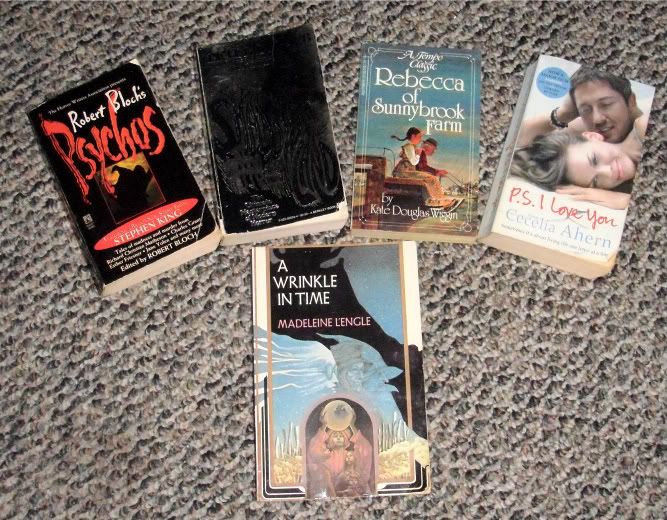
Thrift Store Score 3

In My Mailbox is hosted by Kristi at The Story Siren.

I don't usually do many IMM posts. But today I'm doing one, because I'm kind of excited about the books I've acquired this week.

I did two book buying splurges this weekend... one at the thrift store around the corner from my house... (Seriously... DANGER ZONE.), and one at a local bargain store that is, thankfully, across town.

Here's what I got.

Thrift store (Used books): 

Robert Bloch's Psychos (A collection of horror stories)
Shadowland by Peter Straub (Sorry for the craptacular pic of that one!)
Rebecca of Sunnybrook Farm by Kate Douglas Wiggin 
P.S. I Love You by Cecelia Ahern (OMG, even the first page made me cry!!)
A Wrinkle In Time by Madeleine L'Engle

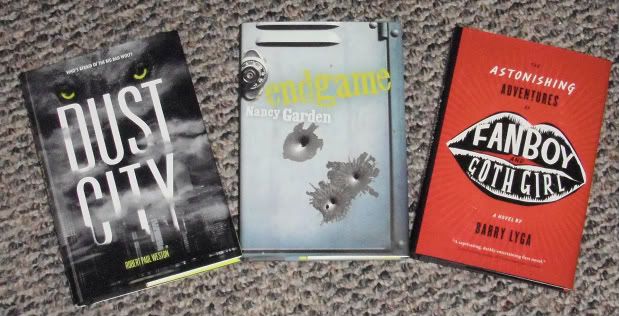
Bargain Store (New Books): 

Dust City by Robert Paul Wilson
Endgame by Nancy Garden
The Astonishing Adventures of Fanboy and Goth Girl by Barry Lyga

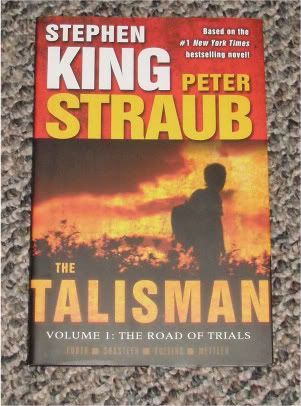
And finally... 
The Talisman Graphic Novel, Vol. 1: The Road of Trials
OMG. I paid $3.99 for this. It's PERFECT. ♥♥♥

Excuse me while I squee all over the place!  SQUEE! :D

The Talisman is one of my all time favorite books, and I've been wanting to read this graphic novel for ages... but budgets being tight, I can't justify buying at full price. $3.99 I can manage though! O_O

All of the books in this week's IMM post cost me less than $20 combined. Super awesome haul this week. 

SQUEEE!!!!

Saturday, March 17, 2012

St. Patty's Day Green Cover Awesomeness

Since it's St. Patrick's Day and green is the color of the day, I thought I'd show off a great green cover I discovered today.

Trash by Andy Mulligan
In an unnamed Third World country, in the not-so-distant future, three “dumpsite boys” make a living picking through the mountains of garbage on the outskirts of a large city.

One unlucky-lucky day, Raphael finds something very special and very mysterious. So mysterious that he decides to keep it, even when the city police offer a handsome reward for its return. That decision brings with it terrifying consequences, and soon the dumpsite boys must use all of their cunning and courage to stay ahead of their pursuers. It’s up to Raphael, Gardo, and Rat—boys who have no education, no parents, no homes, and no money—to solve the mystery and right a terrible wrong.

This cover immediately grabbed my attention. Green is my favorite color, and I love blue and green combinations.
(Orange and green, not so much. Sorry Oompa Loompas. And Jersey Shore.)

So anyway, I saw this cover and I immediately started drooling a teensy bit. It's awesome. The colors, the silhouettes of the boys, the grainy quality, and the birds... I want to frame this cover. Does that make me weird?

Probably...? Oh well.

I didn't actually end up acquiring this book, despite the awesome cover and the interesting sounding story, though I regret that now. *sigh* I just don't have the room and I need to read the books I have before I can get more!

Happy St. Patrick's Day! :D

Friday, February 24, 2012

Friday Flashback Review: Where She Went (If I Stay #2) ★★

Where She Went (If I Stay, #2)Friday Flashback is hosted by Jen @ The Introverted Reader.

Originally Reviewed: March 6, 2011

I loved "If I Stay". LOVED IT. It was one of those books that made my heart and soul ache. It moved me and surprised me and lingered... So much so that I kept mentally comparing the way I felt reading the two books, and I admit to being a bit disappointed by this follow-up.

This is Adam's story. I loved Adam in "If I Stay". He was this incredibly supportive and sensitive and wonderful guy who loved a girl so much that he would do anything for her, who accepted and honored her for being the unique and oddball opposite to him, rather than wanting her to be something she wasn't, who loved her family so much that their deaths were as painful to him as his own family's deaths would be. I liked Adam so much, that I didn't even talk about him in my "If I Stay" review, because nothing would have really done justice to how perfect I thought he was. I don't mean literally perfect, he had flaws, but just perfect in the situations he was in.

Unfortunately, I barely even liked Adam in "Where She Went". I get that Mia leaving him left him heartbroken. I get that. Even taking into account the unusual aspect of the end of their relationship (meaning him supporting her through the accident and the recovery), I just find being heartbroken, anxiety-ridden, depressed and self-destructive for 3 years (with no end in sight) a bit... tiresome. That's longer than they were even together. And yet, after three years, a meteoric musical career, fame and fortune and success, all Adam can do is blame Mia for walking out on him and leaving him cold, and take that bitterness and anger out on others.

I don't mean to sound insensitive. I know that many, many people will find just this thing I found so tiresome to be rather romantic. We all want to be the center of someone's world. Someone's soul mate. I understand what she meant to him, and what their potential meant to him. But with every outburst and cynical thought, I just got more and more tired of it.

I also missed the music that was so much a part of what brought "If I Stay" to life. I know that there was a lot of musical references in "Where She Went", but it wasn't the same. I have no interest in where each of Shooting Star's songs debuted on the charts, or other details of their rise. It's enough to know they made it, for me. What I missed was the way that music mattered, the way they LIVED through music, not just lived by it, or with it, if that makes sense.

All of this is not to say that I disliked the book. I didn't. I liked it, overall. Some parts quite a bit more than others. The writing is still fantastically emotive and brutal in a way. It pulls no punches and makes sure that the reader feels everything (to a fault - see above). I WAS sad and hurt for Adam's loss, and I did want him to find a measure of happiness again... and if not happiness, then closure and acceptance. It's hard to lose those we love. It's even harder to lose those we love after we've helped them through their own lost loved ones. Who's there to help pick up those kind of pieces? I grieved for him for that.

I liked the way that the story came kind of full circle, and Adam did get his closure, even though it came through finding out things that certainly hurt. I liked that he was able to understand and appreciate the decision that Mia made in leaving, even though he was shattered by it. I liked the way he found new reserves of self-respect in himself because of this revelation.

This book didn't live up to "If I Stay" for me, but it is by no means a bad book. I like themes of lasting love, and I think that many people will love this book for that reason, but I just didn't think that this one had the same heart that "If I Stay" had, and for that, I can only give it 2 stars.

View all my reviews

Monday, February 13, 2012

Review: The Knife of Never Letting Go by Patrick Ness ★★

The Knife of Never Letting Go (Chaos Walking, #1)I've heard so many great things about this series, and about Patrick Ness in general, that I was very excited to read this series. After reading the prequel, The New World, and his standalone novel A Monster Calls (and adoring it), I was really looking forward to this one. Unfortunately, I find myself disappointed.

Todd lives on New World, which is a relatively new (20 year old) colonization full of people from Earth. In Prentisstown, the settlement where Todd lives, there are no women, and the men hear all the other 164 mens' thoughts, called Noise, constantly. There's no escaping it. He has been taught that the Spackle released a germ that caused the deaths of all the women, and that the same germ caused the Noise, and also allowed animals to talk.

So when Todd finds a quiet patch out near the swamp, everything in his life changes and he's ushered out into the greater, supposedly empty, world with only his dog Manchee to accompany him. Of course he then begins to find out that things aren't exactly the way he'd been told.

Sounds intriguing... but it just didn't work for me...

Sunday, January 22, 2012

Review: Speak by Laurie Halse Anderson ★★

Speak2.5 Stars
This is an issue book, a book about a terrible thing, and how one person copes with it. I pretty much knew what the unspeakable thing was going in. It wasn't really hard to figure out even before I started, but I didn't feel like this book was about the "what happened", but rather that it was about the "what happens next". In a way, it worked for me, but in others it definitely did not.

I felt a little like Melinda's art teacher, wanting more life and honesty to shine through. Some parts were really good, poignant and realistic... but they were the wrong parts. The parts I wanted the most depth and honesty from were the ones dealing with what happened, with the loss of everyone Melinda could confide in, the inability to make people see her pain. I wanted those things to speak to me, and I feel like other aspects of the book were louder, more focused on. Melinda's sarcasm and wry sense of humor, even if it's just inside her head, for instance. Her observation of the social cliques and school were right on. I liked her voice, her sardonic viewpoint, but I wanted less of that and more of her coping with what happened to her. No... I take that back. I didn't want less of that, I wanted it to relate more to what she was going through. It felt like being inside ANY sarcastic highschool freshmen's head.

The "what happened" part is almost unimportant, except that it's the catalyst for this story. It's supposedly the thing that silences Melinda... but I don't really get that. I can understand her fear, but I don't feel like it changed her much otherwise, and it just seems "off" to me, somehow.

It's the little things that make me feel this way, that there's not enough contrast between "before-Melinda" and "after-Melinda". Her room not having its own Melinda personality and resonance, her routine post-it note communication with her family, her thinking about what her friends will think of a boy paying attention to her before thinking about what SHE thinks of a boy paying attention to her... It's like she has no personality of her own. So her silence doesn't have the power I wanted it to have.

I wanted her silence to speak volumes. I wanted to see the huge changes in her, the unignorable wrongness of her tongue being trapped by fear. I wanted to see all of that and more... even if it was only for my benefit and nobody else around her could see it, if that makes sense. We're the ones in Melinda's head, seeing her world through her eyes and living her life along with her. I wanted to really feel it... and what I felt was more like a very introverted girl than a victim.

When Melinda finally found her voice, I wanted more resolution. I wanted to see the repercussions, for everyone involved, and for Melinda to really find strength and use it... and I felt like that was all kind of glossed over in a "who's the outcast now?" kind of highschool way. Really? No criminal charges? No counseling? Nothing? I wanted strength and inspiration to come pouring out of the last pages of this story, but instead, the story just ends. We can extrapolate and hope that Melinda gets there, but we're technically on our own.

I had very high expectations for this book and I wanted to love it. While I enjoyed some aspects of it, the aspects that I really wanted to shine just didn't. I wanted more, I expected more, and unfortunately, I just feel like this one fell really short of what I'd hoped it would be.

View all my reviews

Sunday, July 24, 2011

Review: Boy Meets Boy by David Levithan ★★★★

Boy Meets Boy Boy Meets Boy by David Levithan
My rating: 4 of 5 stars

There's something about stories like this that just make me cry from sheer pride and happiness. I love when people are who they are, and when they're willing to fight to be happy and not live in someone else's world, but make their own if that's what it takes. It's the opposite of the gut-wrenching, soul-crushing, hollow-me-out-and-leave-me-weeping stories that I love. These fill me up with such pride I just want to SQUEE! all over the place, but end up always getting something in my eye instead... So, I loved this one. This is a celebration and examination of so many things... What it is to be gay, what it is to be a teenager, what it is to be in an unhealthy relationship, what it is to love, what it is to be something other than what is expected of us, what it is to be brave and stand up for what's right, what it is to be a friend... Gosh there is so much in this little book, I don't know how Levithan fit it all in. Maybe he writes really small. I loved this community. Everyone, well, MOSTLY everyone, is so unbelievably accepting and quirky and fun. It's like Perfect Small Town Community, Exhibit A. There's the park with a lake with paddleboats with names and personalities; there's the I Scream Parlor, which serves up horrifying ice-cream concoctions while playing horror movies; there's the music shop run by a couple with polar opposite taste, and the shop reflects that by being split down the middle; there's the movie rental place run by the guy who won't rent to anyone he doesn't know, won't help people find anything, and categorizes based on his own personal thoughts about the movies... and VHS format only. The football team quarterback and the Homecoming Queen is the same person, a drag queen called Infinite Darlene, and our main character's kindergarten teacher outed him for being gay on a progress report and nobody thought this was strange at all. I loved the community, but at the same time, I couldn't help but be a little distracted by the unrealistic perfection of it all. If the world were really like that, it would be amazing. Unfortunately, it's not, so the paragon of acceptance shown here comes off feeling a little cartoonish, a little too-good-to-be-true. This, and one unresolved issue, are the reasons why I can't give this 5 stars. The next town over, where Tony lives, is much more realistic, and this is where most of the stuff got in my eyes and made them water a lot. Tony's parents are of the religious variety, and aren't exactly accepting of their son's preference for boys. Seeing Tony struggle with the two aspects of his life, his parents and his heart, was hard for me. Paul's friendship with Tony was invaluable here. He provided the support that Tony needed to cope with these two warring forces in his life. There were some amazing lines in this little gem of a book. So many quotables that just stand out and shine. I'm surprised that this book doesn't glitter like Edward Cullen on a sunny day. (Actually, this is a library book, and there's something spilled on the back of it, and it seems like it's the image of a Sasquatch. He seems friendly though, from his stance.) Anyway, right. I could kind of quote this whole book, but then it would be plagiarism and that's not cool. But here's one of my favorite sections in the book:
"The first time I met you," he says, not directly to me, not directly to the floor -- somewhere in between, "I honestly couldn't believe that someone like you could exist, or even a town like yours could entirely exist. I thought I understood things. I thought I would get up every morning with a secret and go to sleep every night with the same secret. I thought my life would start only when I was out of here. I felt that I had learned something about myself too soon, and that there was nothing I could do to undo the truth. And I wanted to undo it, Paul. I wanted to so bad. Then I met you in the city and on the train, and suddenly it was like this door had been opened. I saw I couldn't live like I'd been living, because now there was another way to do it. And part of me loved that. And part of me still hates it. Part of me -- this dark, scared part of me -- wishes I never knew how it could be. I don't have the courage that you do."
It's kind of heartbreaking, right? Beautiful though. I really loved this book for everything that it is. On the surface, it's just this happy little boy meets boy book, a little whimsical, and fun, but underneath, it's so much more. I highly recommend it.

View all my reviews

Sunday, June 26, 2011

Review: Roll of Thunder, Hear My Cry by Mildred D. Taylor ★★★

Roll of Thunder, Hear My Cry3.5 stars

Having just finished The Help for the 2nd time, I was already in a place to appreciate this book, and for the most part, I did appreciate it.

The Help takes place in the early 60's in Jackson, Mississippi, during the early stages of the Civil Rights movement. It's a very personal story about 3 women struggling with who they are, both in general and in the environment in which they live. Roll of Thunder, Hear My Cry takes place in the 30's just outside of Jackson, MS, and deals with a lot of the same issues...

Roll of Thunder focuses on the Logan family and their land. Paul Edward Logan bought their land in two parts during hard times after the Civil War, and ever since, the man who used to own it has been trying to get it back in an effort to remake the South how it used to be. Things are not pleasant in 1930s Mississippi. There's a definite imbalance of power with white people having almost all of it, and black people having almost none. This story is about the Logans trying to make a change to that imbalance, even though it is a small one. It's also about finding ones identity, and taking pride in it regardless of what others think or say about you.

Mostly, I really enjoyed this book. It was a quick read for me, and it was brutal and thought provoking. But in a way, it fell short of my expectations. It never really moved me in the way I had hoped to be moved, and even the brutality and the shame and the hurt felt by the characters didn't really affect me in the way that I had hoped it would. I love nothing more than to be heartbroken by these kinds of books, to be left kind of empty and hurting... but I didn't feel that with this one.

Perhaps that is due to the fact that this was told in first person by Cassie Logan, who is 9. On the one hand, this worked in the book's favor because it allowed for a sort of innocence and naivete. Cassie doesn't understand the dichotomy of equality in the South. She thinks that the mistreatment and rudeness are due to forgetfulness and a "grownups vs kids" thing, or just a greediness, in the case of some. She blithely underestimates the fact of skin color in the equation. To her, the hate and the meanness aren't due to the fact that she is black and they are white, it's due to the fact that they just want what her family has (the land) and will do anything to get it back. Which is true, partially, but the fact that they are black gives them less legal ground to stand on, and makes the fight that much more dangerous.

But where I felt that the 1st person lacked was in the rest of the story. It worked well for the innocence and the idealism, but I didn't feel that the family or their neighbors or the story was all that well fleshed out. There were times when I read sections and didn't know how we got there. One minute Cassie is thinking that she needs to do something about the girl who was mean to her, and the next we're in the middle of a protracted plan of action, with no bridge getting us from there to here. This is Cassie's story, so I would expect to at least have a hint of her plans, but instead it felt like it lapsed into a different story for a bit there.

I also felt that some of the things that Cassie saw were unrealistic, and there was a kind of inconsistency regarding when the parents tried to shield her and the other kids and when they didn't or forgot that little ears might be listening. And to add to that, at times I felt that Cassie was kind of annoying in her demands and talkbackitude to be able to tell the story, and that kind of grated on my nerves. At 9, she was both intuitive enough to know when she'd get in trouble for something, but stubborn and oblivious enough to ignore the real potential danger of running off at the mouth... So Cassie heard, and thus told us, a lot more than I think she should have been able to realistically.

Finally, I thought that the ending was a bit of a letdown as well. There was no resolution about the land, or about the secondary plots. There's an ending, a realistic one, likely - but it's unsatisfying. Things come to a head, and then it just ends. This is part of a series, and that probably has a large part to play in the way the ending ended, but I just feel that there was a big something missing, and I'm not sure that I was invested enough in the story to continue on with the series.

I will give kudos to Taylor for telling as honest and brutal a story as she did, and for not softening the blows or the cruelty or the hatred for her readers. At least I didn't feel that she did. There was a palpable feeling of fear and anger throughout the story, as well as menace and a cruel calculation and manipulation on behalf of the men who have the power. A surety that they will win because the law is on their side. I thought that this aspect was very well done.

I am not sure if I will continue on with the series. But I am glad that I read this. It was good, and I feel like if I had read it in school or when I was younger, it would have had a huge impact on me. Reading it today, I can appreciate it for what it is, but I feel like it's missing the impact I wanted it to have.

Monday, March 7, 2011

Review: Shine by Lauren Myracle ★★★★★

Shine(I received a copy of this book for review through Star Book Tours.)

I've never read any of Lauren Myracle's other books. I'm not much into the whole "txt-spk" thing, so those books have never sparked my interest. Not my cup of tea. Other than those, I couldn't have named another book Myracle had written before today. But this... this book called out to me. Not only because of the absolutely gorgeous cover, but because of the premise, and because it's set in the South. I love me some books set in the South. And because it has Issues. Issues with a capital 'I'.

And boy, did this deliver. If it hadn't been written with such grace and honesty, and a light touch and sense of innocence, it could have gone so very, very badly wrong. The Issues in this book are the kind that outsiders abhor and denounce, while those living in and around and with them are almost oblivious to their existence as an 'Issue' at all. To those people, it's just life. Normal. Everyday. This book touched on a lot of things. Poverty, addiction, class division, alcoholism, abuse, homosexuality and homophobia, fear and hatred, small-town politics, friendship and loyalty, etc. So many things that some could have easily gotten lost and confused. But even with all of these issues entwined throughout the story, I never felt that it forgot what it was.

I loved the way this story was written. I love the way it was parceled out, little by little, edging closer to the truth and the consequences and the brokenness, like a hungry mouse sneaking closer to a crumb not far from the cat's bed. The mouse knows that rushing will cause it to lose its chance, to be hurt -- but caution and stealth may win it a chance to survive. This book was like that. It crept along, building momentum, until it reached where it needed to be.

I instantly fell in love with these characters, especially Cat and Patrick. My heart broke for the things that they lost, both before and after Patrick is beaten and left for dead. I loved their friendship, and the simple acceptance of it. I loved Mama Sweetie, Patrick's Grandma, and her kindness and wisdom and faith. I usually find it hard to accept religion in books, because so very often it comes across as preachy. That was not the case here. It was less religion and more a matter of faith - a simple knowledge that there's something and someone there for us. No judgment, no fire and brimstone, no recriminations for every little thought, just a sense of "If you want, you can - if not, that's OK too." I liked that.

This book is gorgeous and amazing from cover to cover, and I was so wrapped up in this community and these lives that I almost didn't want to see, but I couldn't look away. I found one thing, one little thing, about the very end to be a bit unbelievable, but I understand it, and I wasn't disappointed. All in all, I loved this book and I think it's one that I will need to own, to re-read and absorb and love.

It's that good.

Monday, February 28, 2011

Review: Rotters by Daniel Kraus ★★★★

RottersI received an advance review copy of this book from Star Book Tours for review. I requested it purely based on the cover and title - I didn't know anything about it, but I'm kind of morbid so I hoped it would be as good as it looked. I wasn't disappointed.

I didn't really know what to expect... zombies? I was hopeful, I'll admit. I love zombies, and if this one contained them, I had no doubt they would be awesome. But no zombies here, and the more I read, the more I appreciated this for the realistic story it was. This is the story of a mostly normal boy who gets thrust into this very unconventional situation and life.

Here's the gist: Joey Crouch's mother dies, and he is sent to live with the absentee father he never knew, in a small town where hostility reigns, and Joey finds understanding in the most unlikely quarter one can think of - the Diggers... Grave robbers.

I was hooked right from the start. The first part of the book, the fear and the surety and the paranoia, and specifically the specifying, drew me right into to Joey's life and I wanted to know more, and to find out what happens to this boy. His life goes is completely out of control and he has nobody and nothing at all he can rely on, and I found it fascinating how he dealt with - or failed to deal with - this new life he's got. His struggles were what kept me glued to the book. He was nothing if not real. His mistakes and compulsions frightened me on his behalf. I love an underdog, so I wanted him to persevere and prevail against those against him... and against himself.

I loved the fact that the students at Bloughton High were realistic. They may have been a little cliche, actually, but teenagers ARE cliche. The jocks are jocklike, the snooty mean girl is snooty and mean (and a girl), the outcasts are outcast. But the devil is in the details with these kids, and I thought the portrayal was great. Just enough to read into them and make them more than cliche without needing it to be spelled out in big bold letters. I loved Foley. He may have been my favorite character. I wished that he was a bigger part of the book, actually.

I also liked the Diggers. They were a varied and interesting group, and I loved their independent camaraderie. I love the history and the mostly noble feel of these men, and the sacrifices they make for this calling. I was fascinated by the way that the Diggers behaved among the dead, especially The Resurrectionist, as it was such a contrast to his behavior with the living. I would have loved more history and lore and more detail regarding the Diggers and their profession, but since this was Joey's story, and he's a 16 year old, I know why this would have been a mite tedious for him to relay.

I appreciated the unflinching way that the dead and that death were portrayed. I liked that there was a certain reverence and respect there, even among these men out to pry valuables from someone's cold dead fingers. There was quite a bit of gore and grime and muck, among other foul things, so this is probably best not read by those weak of stomach or virgin of ears (so to speak). But I thought that these details added a lot to the book - a kind of reality and truth that it might otherwise be lacking.

I really enjoyed the writing in this story, and many passages were gorgeously descriptive and evocative. I loved the contrast between these parts and the gritty and almost irreverent brutal honesty of the rest of the story. This one pulls no punches regarding bullying or loss, or about growing up and finding one's own path either. I really enjoyed it. I will definitely be on the lookout for more from this author.

Saturday, February 19, 2011

Review: The Emerald Atlas by John Stephens ★★★★★

The Emerald Atlas (Books of Beginning)I requested this book thinking that it would be a fun and magical children's story aimed at 8-10 year olds, like with the Percy Jackson series, but I was really surprised by the complexity and depth in this book, as well as the darkness, and loved every minute of reading it. I'm actually a little disappointed that I'll now have to wait for so long to read the next book and see what happens.

Kate, Michael and Emma have been shunted from orphanage to orphanage for 10 years, since being removed from their parents' house one Christmas Eve with a kiss and a promise that they'll be reunited again... one day. Then, after missing their last chance at placement with a foster family, they are sent to Cambridge Falls, where they stumble on an adventure that has been both 15 and thousands of years in the making.

This story reminded me of other children's stories - but only little bits and pieces. There was nothing I could really point to and say, "Oh, he was inspired by THIS story here," or anything like that, it was more just an impression that I had. I was reminded of Harry Potter, only kind of in reverse, with the opening scene of the children being taken away from their home. I was reminded of E.Nesbit's stories as well throughout the book, mainly by the tone and the family loyalty theme. I was reminded of The Lion, The Witch and The Wardrobe a few times, and The Hobbit a few times, etc. But again, these were more like impressions that I had, rather than feeling like anything was actually borrowed from what came before.

Despite feeling a vague sense of familiarity with these books, I felt like The Emerald Atlas was very original and different. I loved the concept of time travel, and how it actually came about. I thought it was just the right level of complex to logically and magically work, but was still explained in a way that everyone could understand and follow. The storyline was exciting and the creatures and characters were all interesting.

I loved the characters - they were all believable and identifiable to me, and I couldn't help but love them and their loyalty. Kate is the eldest, and promised her parents that she would watch out for the others. She's got a load of responsibility on her shoulders to match Atlas (which is pretty significant, actually), and she's got a heart of gold. She just can't stand seeing anyone suffer or hurt, and instantly falls into a nurturing role when needed. Emma was my favorite, I think. She's the youngest, and the type of girl who's strong and forceful because she cannot take being hurt, not when that's all she's ever known. She's quick to love though, and her love is a little desperate and fierce. I loved her and I can't wait to see her next adventure. Michael, the middle child, was hilarious. A studious Dwarf-scholar, he is the smart and logical one of the trio. He was constantly making me laugh by his bald-faced awe in a lot of the situations they were in. I truly loved how each of the children brought their own unique aspects and each played and intricate role in the story and worked as a team. I was glad that they had trials, because they each had time to shine.

There was a lot more that I loved about this, but I think that I'll just recommend that you read it yourselves. I highly recommend this one - for readers of all ages.

Wednesday, January 19, 2011

Review: Crusade by Nancy Holder & Debbie Viguie ★★

CrusadeI received this book as part of an ARC tour from Star Book Tours. I had actually forgotten that I had requested it, and when it showed up on my doorstep, I was a little surprised. But opening it up, I can see why I would request it - it looks like it would be awesome. Dark and gritty and bloody, just like a vampire book should be.

In in many of those aspects, this book delivered wonderfully. The vampires were vicious and cruel and bloodthirsty, and there wasn't a sparkle to be seen. The fights were pretty intense, and the action was written well and was exciting. I also liked the political facets of the story, and how they corresponded with other wars from our past. History repeats itself, just with a new bad guy each time around. If these are the things that you're looking for, you will enjoy this book, and probably the series.

I was hoping for a little more, and so I admit that I am a bit disappointed with this one. I think that this book had great potential, but I think that it got lost on the way.

First, the characters didn't feel authentic to me. Almost all of them were very stereotypical and one dimensional to me, with few exceptions. Holgar was one exception. I loved his character throughout the story until the last 50 pages or so, until he seemed to change before our eyes into someone suddenly dark and secretive - most likely a lead-in to the next book in the series. The same with Father Juan. We're supposed to ask: Who are they really?

The rest of the characters didn't do much for me. Jenn was at her most interesting when she was on her own. With the others, she was bland and boring. The group dynamic quickly got on my nerves with all of the in-fighting and I kept thinking that they would be better off if they went their separate ways and each had a book to follow their adventures alone. Maybe then we'd get to see more of their character and the focus would help them to come alive. I doubt that will happen though.

Then there is the writing itself, which was inconsistent. I know that the edition I read was an uncorrected edition, so I'm not talking about the grammatical errors or spelling errors, but the writing itself. For example, in the midst of running for her life from a pack of vampires who want nothing more than to kill her, and trying to rescue her sister from still more vampires, we have this:

"The sun was setting; she could feel it as surely as she felt the pounding of her own heart.
The heart that beat for Antonio."

It then goes on to talk about how afraid she was that she would never see him or her sister again. And then back to Jenn trying to save her own life so that she could try to save her sister. It just seemed incredibly out of place to insert a line about her heart beating for someone else when she is literally running for her life. I know that in times of stress and fear, we think about those we love, but the line itself is strange and awkward to me, like it was inserted to create a relationship link to him.

Not to mention the chapter headers that contain Jenn's diary entries. These are written in such flowery and formal language that it doesn't mesh with the self-conscious and unsure 17 year old "Just Jenn" from the rest of the story.

And then finally, my biggest issue with the book is the way that religion and faith is handled. This book could be considered a Good vs Evil story, and so it stands to reason that a certain amount of religious comparisons could be made. That isn't really my complaint, although it does get quite preachy at times.

My complaint is that in this mixed cast, we have several different religions and belief systems interacting with each other, but no matter which belief system a character lived by, they approached it in a Christian-oriented way, or otherwise acted in Christian ways that did not fit with their own beliefs. I felt like, since it seemed that it was a deliberate choice to have so many different personalities and faiths, they should have rung more true, rather than all centering around what is referred to more than once in the book as the "One True Faith".

For instance, we have a Wiccan "White Witch", who practices magicks and worships the Goddess and the moon and nature, etc. But then, in a moment of uncertainty, she considers going to a Catholic priest to give her absolution, rather than relying on her own beliefs. This is just one of the examples of this from the book, and there are quite a few. This, more than anything else, made this book less than enjoyable for me. I couldn't help but wonder: Why go to such an effort to include the variety of religions and faiths if the characters do not act according to them?

I think that if handled differently, this book could have been a very enjoyable one for me. I think that people should believe what works for them, but this just felt like the message we were supposed to take away is "You can believe whatever you like, but in the end, it's all the same thing, you'll see."

Overall, I thought that this book was OK. I think that people who are just looking for an exciting read will really enjoy it, especially those who are fans of Buffy the Vampire Slayer.

Saturday, December 18, 2010

Review: Mockingjay by Suzanne Collins ★★

I am probably one of the last people on Earth to read Mockingjay. It was one of the most highly anticipated series ending books ever. Everywhere I looked someone was talking about it - counting down the days till release. There was ARC craziness and spoiler worries and giveaways offering the book sprouted up like weeds (including one of my own!), but I just now got around to reading it myself, and I was more than a little disappointed by it.

Without further ado... My Mockingjay review.


Mockingjay (The Hunger Games, #3)I'm really torn on what to rate this book. I went back and forth between 2 and 3 stars a few times, but I ended up going with 2 stars for a variety of reasons that I hope I'll be able to convey. I don't think that it was terrible, I was disappointed and irritated by quite a lot of it.

I will try not to spoil the plot, but if you haven't read the book, read the following at your own risk:

First things first... In The Hunger Games and Catching Fire, I cared about Katniss and Gale and Peeta. They were just these kids who were unlucky enough to live in this society that puts on this horrific event every year. They were born into hard lives of hunger and uncertainty and fear and control, and then victimized and picked off annually for the entertainment of the nation. I felt like I understood Katniss in HG (Hunger Games) and CF (Catching Fire). She didn't have a choice how to live, but she did her best to make a place for herself and do what she could to survive and not become a monster. The same went for Gale and Peeta - they did what they could do and tried to be decent.

But in Mockingjay (hereafter called MJ), I didn't feel like I knew the characters at all! I know that there had been a lot of changes and a lot of hard choices and pain and all of that, but in a matter of 6 weeks from the end of the Quarter Quell that ended CF to the beginning of MJ, it's like ALL of the characters that I loved and knew had changed into cruel, angry and unrecognizable goblin versions of themselves. I was really hard pressed to find anything redeeming in any of them quite a lot of the time.

Katniss is aloof, angry, consumed by self-loathing and guilt, and just shuts down and shuts everyone out. Gale has become this cold, calculating tactician who has none of the warmth that he had before - not even when it comes to his best friend who is clearly struggling. They argue and fight all the time, even when Gale is supporting Katniss - and even during these times (because he DOES stand by her), she is horrible to him and everyone else. Selfishly acting like she's the only one to have suffered or feared anything.

And that's not even to mention Peeta. He is nothing, NOTHING, like the Peeta we knew in HG & CF. Granted, he has valid reasons (more valid than Katniss's selfish ones) for this change, but it was frustrating all the same - and even more so because of the way that Katniss reacted to him.

Again I will stress that I understand the pressure that they were all under, and the atmosphere of fear and uncertainty and impending war and all that. I understand it, and even appreciate it, but I felt like the way Collins handled it stripped Katniss, Peeta and Gale of their humanity. These are teens who have had to live through situations that most adults have never lived with - the pressure is intense. But I couldn't really care about any of that because these characters seemed so robotic and cold and unreachable. All of them. And that's incredibly disappointing to me. Even when Katniss and Gale were allowed special privileges to go hunting together as they used to, there was not really any closeness or friendship or support between them, no vulnerability. You'd think that they would rely on each other for support, but the relationship was completely one-sided, with Gale supporting Katniss and Katniss acting like the world is on her shoulders alone. I wanted her to rely on him - ANYONE - and let go a little... to not hold everything inside. To be human. But even when she did break down, it was so clinical and sterile I just couldn't care.

Buttercup the cat, who had, at best, bit parts throughout the series, evoked much more emotion from me than any of the major players. Yes... A cat. And Prim is her usual, wise-beyond-her-years, caring, bundle of goodness and strength. I loved her. She is really the only human character next to Finnick, who I came to really like in this one. He was vulnerable and human.

So, yeah. My main complaints were regarding the characters themselves. Many times they would act completely out of character, Katniss especially, and I found it frustrating.

=====================SPOILER========================
====================================================

For instance... After wallowing for the entire book and keeping a running list of all the people who have died or been hurt by her actions, Katniss votes YES to hold one last Hunger Games with the Capitol's children, so that they know how it feels. WHAT??? After going through two of them herself, trying to save as many as she could, after becoming the Mockingjay to END the regime that forces the Hunger Games on the people of Panem, she would vote yes to send more innocent kids to slaughter? That makes no sense to me at all.

====================================================
=====================END SPOILER====================

And then I have to say that the way the end was resolved didn't make sense to me. The twists, yes, they made sense and weren't unexpected. But I didn't really feel that Katniss was A) given enough information to lead her to the conclusion she came up with or B) clever or shrewd enough to get there on her own. And if she was, which again would be out of character, then why was this not conveyed? Katniss is telling this story - we get her every thought - even when all that entails is a refusal to think of something.

I wasn't disappointed by the relationship aspect - or lack thereof - in this story. Considering that I didn't really like or care about any of the characters, I wasn't exactly sitting on the edge of my seat with fingers crossed hoping for a certain outcome. It was not what I'd expected, but I was OK with it.

Regarding everything else, I thought that the dystopian themes and the events in the story (almost all of them) were good, and the pacing was great. Not everything was wrapped up how I would have liked, but it is a definite end, and for that I'm glad, because I don't see how another book in this series would be an improvement for me. I can see why some would really like this, but all in all, I was not thrilled with it.
View all my reviews

Since writing that review earlier, I've thought of more stuff that I should have included in it, like (Spoilers!) how the situation regarding Prim's death felt like it was manipulated by Collins to point at Gale being responsible, which felt like a ploy to shift all of the shippers to Peeta's team and make Katniss hate him, and subsequently Gale moving to District 2 and ending all communication with Katniss. This is so out of character for him - the guy who stood by Katniss through thick and thin and never wavered, I just can't imagine him giving up on her, or her casting him completely out of her life. (End spoilers.)

There's just so much that I felt was out of character and misrepresented. It seems silly to use that word since the story is Collins', but it feels true. It's like Mockingjay forgot who it was really about. I felt like the characters that I loved were gone, and there were angry, sullen, vicious strangers in their places. Very disappointing.

Saturday, November 27, 2010

Review: Zan-Gah - A Prehistoric Adventure by A. R. Shickman ★★

Zan-Gah:  A Prehistoric Adventure (Zan-Gah, #1)This story is about a teen in pre-historic times, and his quest to find his twin brother who disappeared over a year ago. Zan-gah is brave and proud, and sure that if he starts his adventure, he will be rewarded in finding his goal. He encounters a lot of dangers and obstacles along the way, but never gives up hope.

I wish that I could say that I loved this book as I really enjoy adventure stories, but unfortunately, I had quite a few issues that I could not ignore. Overall, I thought it was OK, but I thought the concept could have been great and I had hoped for more.

First, I felt that the writing seemed to talk down to the reader. I know that this is a children's/young adult book, but readers still want to be immersed in the story and see the events through the characters' eyes. This was a book full of events that were told rather than shown, and after just telling the reader what happened, we were then told, with italics or exclamation points, what the events or actions meant, as if the reader would not understand. Perhaps these little asides were intended to draw in the reader, but to me they felt a bit condescending and repetitive. I think that this was done more to clarify what was happening than to condescend, but I didn't feel that the reiteration was necessary. We should be able to gather from context what a particular action or scene signifies, and examine that scene in relation to our own experiences. If every event is explained, we have no need to look for any other meaning or significance to ourselves, and it's then harder to connect or identify with the character without that bond.

I felt that the characters were interesting and diverse, but I didn't really feel as though I understood any of them. I did root for everything to come out OK in the end, but I couldn't really identify with the characters regarding their lives or choices or actions. I kept being surprised by the decisions that Zan made, because they were different than the ones that I would have made in his place. In a way this is a good thing, because I do generally enjoy unpredictable characters, but I admit that it did make me feel as though I didn't know Zan at all.

The second issue I had was the language used. It felt modern and out of place with the setting. The character names are all seemingly appropriate, and certain words in the presumed language of the pre-historic people, but then we have a teenage main character using modern English words like "proficient" that obviously didn't exist then. It just stuck out and unfortunately didn't work for me. Again, I realize that this was probably done in an effort to make the story more accessible to younger readers, but it was distracting and took me out of the story.

The third issue that I had was that there was just too much I found unbelievable. There were close calls, sure, but every time there was the least amount of trouble, the characters would find an incredibly convenient way out of it with little or no effort at all. Yes, Zan-Gah is described as resourceful, but he didn't really show this quality - and when he did, it was not his resourcefulness that benefitted him, it was luck or someone else coming to his aid.

There is a theme of unity and working together and loyalty that appealed to me, however. Zan-Gah helps to facilitate between his clan and those of his neighbors. Although it was effected very easily, with little more effort than gathering the people and making a short speech, still, he enacted a change for the better, and I did like that. I also liked the fact that he did not give up hope of his brother, and went to try to save him, against all odds, and knowing that he may never return. I was proud of Zan-Gah for his bravery.

I think that this book is one that younger readers may enjoy.

Tuesday, November 23, 2010

Author Interview: Stephanie Dray, author of "Lily of the Nile"

Stephanie Dray is the author of the soon-to-be-released Historical Fantasy novel Lily of the Nile, a novel about Princess Selene of Egypt. From the moment I saw the beautiful cover of this book, and read the excerpt on Goodreads, I've wanted to read Selene's story, so I am thrilled to have the opportunity to find out more about the book from Stephanie herself in preparation for its release in January 2011.  Read on! 

Q: Both you and author Michelle Moran have written books about Cleopatra's daughter, Selene. What inspired you to write about her?

A: I've always been interested in Cleopatra VII. When I found out that she had a daughter--one who survived to become Queen of Mauretania--I had to know more. Imagine the life of a child whose parents both commit suicide, a child who is taken prisoner and dragged through Rome in chains, only to charm her way into power. That was an irresistible story for me. What made it more interesting is that Selene lived through a period of great social and religious transition. I wanted to know how her life fit into that context and I was moved by every new thing I discovered about her.

Q: Lily of the Nile is a historical fantasy - Did you know from the start that this was the type of book you wanted to write? If not, how did it change from what you had intended?

A: Originally, the story I planned was more historical fantasy than historical fiction. I wanted to write an alternate history where things turned out differently. But the more I researched Selene's life, the more her actual circumstances touched me. For example, though she was only ten years old when her parents died, she never forgot them, or any of the family that she lost. The relics found from her reign in Mauretania show frequent references to her mother and to lost loved ones. This is a little girl who grew up to be the last Ptolemaic queen, and her desperation to hold onto her heritage resonated with me and seemed like its own little bit of magic.

Q: What was the most difficult aspect of researching for a book like Lily of the Nile?

A: I can't read or write Latin or Greek and that was a huge limitation for me in my research. Having to rely upon English translations frustrated me. Also, there's a great deal that we know about the Augustan Age, but references to Selene are brief and tantalizing. For example, both of her brothers simply disappear from the historical record. Some historians suggested that they went on to live obscure lives with their sister but modern historians theorize that they must have died young or they'd be mentioned. There's a danger in making assumptions when we have so few surviving historical accounts, and those that we do have were often written hundreds of years after the fact. I try to approach historical mysteries without any hubris and am willing to admit that there are things we just don't know and might never know.

Q: I am very much a character reader; for me to enjoy a story, it has to have realistic characters that I can identify with and care about. What is the one "make or break" aspect a book must have for you to love it?

A: I'm with you. It's all about character. I can't get into a book, no matter how well written or clever, no matter how fast the plot moves, if I don't have a reason to care. Selene speaks to me as a character, and as a historical figure, and that's what makes the book for me.

Q: Can you talk about one aspect of writing and/or publishing that surprised you, either positively or negatively, and what you would do differently if you had the chance?

A: If I had the chance to go back and write Selene's story as one giant novel instead of three smaller books, I think I would have done that. I didn't understand the women's fiction market very well when I started writing, and I thought, nobody will buy a book that big!

Q: Have you ever been surprised by the reactions of readers? For example, readers loving a character that you disliked or vice versa?

A: Every now and then a reader will surprise me by wishing that Selene was a sweeter, more innocent girl, who never feels rage. A lot of fiction out there revolves around heroines who never lose their temper, who always do the right thing, who never struggle. I'm not very interested in those kinds of heroines and I rarely write them. What's more, I don't know any real women who are like that. Selene had a very difficult life and she has plenty to be angry about. She loves some of the people she's supposed to hate and she hates some of the people she's supposed to love. She tries, she fails, she changes, she becomes. I love her for that.

Q: I know that there is a sequel in the works - are there more books in the series planned?

A: The next book in the series will follow Selene on her journey to Mauretania as its young queen. It's in this book that she becomes the emperor’s most unlikely apprentice, and the one woman who can destroy his empire…

Q: Do you have any "quirks" regarding your writing habits? Like writing longhand and then typing it up, or using only a "lucky" font, or needing absolute quiet or loud music or background noise?

A: I like to have my kitties sleeping beside me when I write ;)

Q: Who or what is your favorite mythological figure or creature?

A: I have to go with nymphs because they are a primal expression of the mystery that women represented to the ancients. They lived outside of civilization and social norms. They were wild and alluring and even dangerous. They were the original bad girls of the ancient world and I love them for it.

Q: I'm sure you get the same types of questions all the time, so what is the one question you wish someone would ask you, and the answer you'd give?

A: I'd like someone to ask me if I really hate the ancient Romans. Selene's perspective in the book is very slanted. She hates the Romans and thinks everything they do is bad whereas everything about her mother's Egypt is good. This is a biased point of view and one that I intentionally adopted for her. Unfortunately, people think it's my point of view. I have enormous respect for the ancient Romans and I'm well aware of the influence they've had over our own culture. In fact, don't tell Selene, but I even have quite a soft spot for Augustus!

Thank you so much, Stephanie! I am extremely excited to read this one, and I can't wait to get my hands on it! :)