Showing posts with label ebook. Show all posts

Saturday, February 13, 2016

Review: Ask A Queer Chick


Disclaimer: I received an advance copy of this book free for review from NetGalley.

I've been putting off reviewing this book for five days now, which is pretty unlike my usual habits. I try to review everything as soon as I finish (unless it's like 2am and I have to get to sleep because I have work in the morning and need to actually use my brain for something other than filling the vacuum of my skull cavity), and it really bugs me to have unreviewed books staring at me every day from my Goodreads homepage.

But... I am a little daunted by this review. I have so much that I want to say and quote and point out... and I know that no matter how hard I try, all of that greatness is just not going to appear as part of this review. The longer I put it off, the less I'll be able to put into words all of the things that I want to say, and it might already be too late. Oh well, c'est la vie, right?

I just happened to be browsing NetGalley one day and this bright yellow cover caught my eye, as I'm sure, it was designed to do. Then the title hooked me, and I was instantly curious as to what this book might contain. I've never heard of The Hairpin, the site that contains the Ask A Queer Chick column. I had no idea what to expect, other than the obvious LGBTQ content. Would this be a lesbian manifesto? Or would it be a hilarious collection of questions and answers that, while funny, are relatable and insightful and meaningful? Would this just be another one of those blog-to-book conversions that just takes a bunch of the content of an existing successful project and re-publishes it in book form? Turns out, it was all of those things and more.

So… No, this is not just a book that consisted of "Export blog/Publish book". King-Miller mentions in the introduction that she decided to go for more of a narrative form than a question and answer form, which, I admit that I was a teensy bit disappointed by initially, because I thought that it might preclude possibility number two from existing, there being no questions to answer, after all. But it turned out to be the best of both worlds, the advice and answers to questions that could be asked, rather than just cherry picking interesting questions and answering them specifically. I feel like there was a lot more ground covered and information provided this way.

There was much of that relatable, insightful, and meaningful content, and quite a lot of humor as well. I really enjoyed it and found it entertaining as well as informative. There was a delightful tongue-in-cheek tone to the writing that had me giggling unexpectedly. I really enjoyed that.

However, some of the "humor" came about in the form of crudeness and vulgarity. I realize that the previous sentence makes me sound like I should put down the Prude Juice, but I promise you that I don't have a problem with it for the language or crassness itself (on the contrary, I'm the target audience), but rather for the image that it presents of the work, the writer, and the culture. Being a lesbian doesn't automatically mean that one is vulgar and crass, does it?

I believe that the author tried, and succeeded, at aiming this book towards the hip and cool people of her generation. The problem is that that's not the only type of person who might read or find this book useful, and the language and tone may turn away people who might truly benefit from it.

Part of what this book is about is inclusiveness and acceptance, yet I think that the casual crassness could alienate some readers. And that's the crux of my language and tone complaint with this book. I would expect this book to be a professional piece of writing, and for the most part it is - except when it isn't. It doesn't bother ME, but I can see some, perhaps older women who are figuring themselves out later in life, who have lived for decades in a heteronormative society, who are more traditional-minded, etc, reading this book for help and guidance through their questions - and feeling that this book really isn't for them after all. And that makes me somewhat sad.

Now I understand that the whole "accept me for who I am and who I present myself to be" argument is valid. But that's an idealistic, perfect world situation that doesn't exist right now (or ever) - and honestly I don't think that one's sexual preference or gender identity has anything to do with how professionally they present themselves in their work. And that's why I think that a book like this, one that's hoping to cross boundary and party lines, provide advice and guidance and support for everyone who may need or want it, should try to be as neutral as possible to include anyone who may potentially find it.

I only criticize for this because I think that this was a very informative, very interesting, and I think helpful book, and could benefit a lot of people who might be curious or struggling with how to deal with their sexuality or gender representation. I learned quite a lot myself, even though I'm not struggling with either of those things. This is a book that I think many, many people should read, regardless of their identification, and I want it to not offend them away by poor language choices.

Speaking of word choices, I did think that it was a bit strange that "elide" was used twice in place of the more common "omit" or "remove". Just seemed like a strange choice to me when so much of the book was straightforward, common language, and yet here's this uncommon word that just felt out of place.

Finally, and I know that this is perhaps not fair to bring up, but I am sorely disappointed in the version of the book that I got from NetGalley for review. At the end of the book, there's a whole slew of resources provided. The websites are OK, but the phone numbers are a horrible mess.

Examples:
"GLBT National Hotline Hotline Hotline Hotline 4564): peer counseling, information, and local resources"
"GLBT Youth TalkLine alkLine alkLine alkLine 7743): youthspecific [sic] (under twenty-five) peer counseling, information, and local resources"

There are six of those that are just like that. I really don't understand how that happens. It really seems like the number was formatted out or copied over or something. The little conspiracy theorist on my shoulder is whispering that it's to sell the book for the complete resource list, but that doesn't make much sense since anyone getting a NetGalley freebie would have access to the internet and could easily Google these resources for free.

OK, and just because I'm on a roll with the criticisms, there's no treasure map in The Lord of the Rings. There is one in The Hobbit, but only if one considers a regular map showing the way back to one's dragon-infested mountain home, and the way to get inside where there happens to be treasure, to be a "treasure map". (I don't… I think of pirates and The Goonies when I think of "treasure maps". But maybe that's just me.)

And since that now seems like a SUPER random comment, I'll provide the text that I'm referring to (bear in mind, that this is obviously an uncorrected edition, and this may have changed in the final copy):
"Some people will try to convince you that you have only one true identity, and that your job is to find it, possibly by acquiring and following some sort of Lord of the Rings-style treasure map."
You may now begin yelling "Nerd!" in my general direction.

And just ONE more, because this one really could have used some elaboration for me, but why is Google Chat and texting taboo as methods of coming out, when Facebook or Twitter status updates are A-OK? I just don't understand. I need more info than just "Girl. Don't."

OK, Now I'm really done with the negatives (I think). I really found everything else about this book to be pretty great. I think quite a lot of it, from the 'figure out who you are' and 'figure out what you want' bits to the 'don't settle for crap' and 'you're not alone' bits can all apply to everyone. But the segments that really do apply only to the LGBTQ community were great as well. Informative for me, at least, in how to relate to people in the way that makes them the most comfortable, and to see things from different perspectives than the one that exists inside my own head. It even validated some things for me that, I admit, I thought were just attention-seeking behaviors on Facebook. That's ignorant of me, and I'm glad that I read this because I've now had my eyes opened to a whole spectrum of possibilities. That alone is well worth the read.

So... all in all, I think that this is a book that everyone should read, even if you feel that you are open and accepting and forward-thinking. I thought that I was, but even I learned some new things from this book.

Saturday, April 20, 2013

Review: Portrait of Lisane da Patagnia by Rachel Swirsky ★★★★

Portrait of Lisane de PatagniaThis is the second short story that I picked up from Tor for free - again, I was drawn in by accolades - this was a Nebula Award nominee - but mostly I was hooked by the cover. I LOVE the cover... it's almost vampiric, like the taller woman is breathing the life right out of her victim. I love the haunted quality the woman in white has, and the way she seems to be basking in the theft of her. I love the kind of greedy sensuality of the cover.

These are the things that I thought when I picked this up. I didn't notice the paintbrushes, and despite the title, I didn't really think of this book being about art. I don't really read book descriptions much, and I didn't read this one. I read it while I was reading the story though, and I almost wish I hadn't, because even the one sentence teaser of a description caused me to assume things about the story. Which is why I don't like to read them in the first place.

I was not thrilled with the other free Tor story I picked up. It told everything and showed nothing, it lacked substance and meaning and just did nothing but disappoint me. In comparison, Portait of Lisane de Patagnia had all of that. The writing was evocative and descriptive, and the story was interesting and compelling. I wanted to know where it was going.

It seems like I've been reading a lot of stories about art as a method of creation, but not very many stories about art as a method of destruction. But really it wasn't so much about the art, this story. It was more about the relationship between this particular artist and her subject, between teacher and student, lovers. It was about the bitterness that can be created when hopes and expectations aren't met, and how that bitterness can create something new and powerful in its own image.

I really enjoyed this little story, though there were times when I was a little confused, because the narrative jumped around from present day to scenes from the past, and there wasn't always a clear delineation between them. But it wasn't difficult to keep up with the story, I just had to backtrack a couple times.

I can't say that I really liked the characters, but I could identify with them and I had no trouble understanding them. I am always a little impressed by this in short stories, because it seems to me that identifiable characters are hard for many to write even in full length novels, so to do so in only 32 pages makes me happy. There are only a few authors that I've seen write stories this short (or shorter) that have well-written characters, and they are among my favorite authors. I take this as a sign that I may need to search out more of Swirsky's books.

Friday, April 19, 2013

Review: Swift, Brutal Retaliation by Meghan McCarron ★

Swift, Brutal RetaliationI picked this ebook up when Tor was offering it for free a while back. Apparently this story was nominated for an award, and based on that, and the title, I thought that it would be the kind of story I'd like. Sadly, I am disappointed instead.

I really don't know why this story would have been nominated for anything other than a re-write. It had potential to be really great, but everything that it could and should have been was missing, which is a shame. Everything in the story is just told to the reader: Ian died. Sinead did this to Brigid. Brigid did that to Sinead. Their mother cried. Their father stomped upstairs. Everyone was angry at everyone else, and most of it was misplaced. This last was literally told to the reader just like that. Cold. Distant. There's no reader investment in the characters, or the story, no emotional content at all, despite this being what could have been a really emotionally charged story of two sisters' relationship changing in the wake of their brother's death. There was no growth, no change, nothing was learned, there was no ending... this story just contained a bunch of things that happened and then ended as more things were happening.

I don't even know what the point of this story was. I thought I knew, while I was reading, but it was like a square peg being jammed into a round hole. It just didn't fit.

The more I think about it, the more disappointed I get. It's a shame, really. This honestly could have been a great story if there was just some spark of life in it somewhere. Some growth, something in the characters that made me feel for them. Instead it was just sad in a I-feel-sorry-for-this-book way, not in an emotionally sad way.

Blah.

Saturday, April 13, 2013

Review: The Devil You Know by Mike Carey ★★★★

The Devil You Know (Felix Castor, #1)Despite like 20 people I know having read (or wanting to read this), I'd never heard of it until discussing the best Urban Fantasy books and series... And then, because I'm half-demon myself, this one stood out from the crowd and sounded like it'd be something I'd really enjoy. To be quite honest, I'm a little tired of the vampires and the werewolves and whatnot, so demons and ghosts seemed like a nice change.

And it was.

I really enjoyed this book. I've been in a bit of a slump lately, and so it seemed like it took me forever to read this, but I got there in the end and I liked it a lot. I loved the kind of... gritty realism the book had. It felt less like fantasy than real life - if real life had ghosts and demons and those who were capable of seeing and dealing with them.

This book seems to come with an intertwined recommendation: If you like The Dresden Files, read Felix Castor. And vice versa. (Again, odd, because last year I read EVERY SINGLE HARRY DRESDEN BOOK THERE IS and Felix was mentioned not one time to me... HMPH!) Anyway, I can kind of see why, because Felix and Harry both kind of have that snarky, just-a-guy-who-can-do-stuff thing going on. But, they were quite different, too. I've been thinking about it this morning, and it's taken me a little bit of time to realize it, but in SOME ways, I liked Felix more than Harry. (What? Like it's WEIRD to brood over fictional characters or something. Pfft.)

I don't want this to be come off sounding like a criticism of Harry, because it's not. Some of the things that I'm going to mention are parts of WHY I love his character so much. But they work in HIS world - not so much the one that Felix lives in.

First, Harry has this kind of (to use Hermione's words from The Order of the Phoenix) "saving people thing". He's chivalrous and kind-hearted with a dirty mouth and a quick temper. He has a lot of internal doubts about his ability to be the man -or the wizard- that he needs to be. Which is, of course, what makes him that man/wizard. Harry Dresden knows who he is and what his powers can do, and he has a kind of feeling of responsibility to use them to help people. I love these things about Harry, because the man that it makes him (without giving anything away) is one that I love and pity in equal measures.

But Felix was... just a guy. And I liked that. OK - maybe just a guy who was slightly more in tune with the no-longer-alive than most other people. He didn't have the hero thing going on. He didn't really head out into the fray to protect "his" city or to do good deeds... he just got caught up in a mess. He has his own doubts, his own dark history, his own fears. I really hope to see more of this in the remaining books in the series.

I liked the plot as well, and I think that it lent a good deal to the realism of the story. This was an already fucked up situation that went completely FUBAR, and then some. There are books (like The Dresden Files) where the fantasy is so entwined that to remove it would be impossible - and I wouldn't want to. But then there are books like this one, where the fantasy aspect is more... like an addition. Take away the ghosts and demons and whatnot, and you STILL have a really good story. With them, and you have a really good urban fantasy story. And I really liked that. But the fantasy aspects never felt tacked on or like an afterthought. They meshed perfectly with the story and the world, especially old city London with all its history, and I loved it.

I will definitely be reading more of this series.


View all my reviews

Saturday, March 30, 2013

Review: The Unbearable Lightness of Being by Milan Kundera ★

The Unbearable Lightness of Being13% and I'm done.

I have had a run of books that have bored me, or annoyed me, or just did nothing for me. This one is... You know, I don't even know how to describe this one.

I pretty much hated it from the first page. I do not understand the high rating on Goodreads for this book. I can barely stand the thought of picking it up again and reading more of the words telling me things about characters that I could not possibly care less about.

We have Tomas, whom we meet standing on his balcony and vacillating between whether he should ask a woman that he's "in love with" (read: met in a chance encounter and became infatuated with) to move in with him. He's saved from making any kind of fucking decision by her showing up on his doorstep (literally) with her bags packed and ready to move in. Which she does. And then she clings to him (literally) every night - to the point that he controls her sleep patterns. He even, charmer that he is, fucks with her partially-asleep mind and tells her that he's leaving her forever, so that she'll chase him and drag him back home.

Tereza (that's the woman - I had to look up her name) begins to have nightmares that he's cheating on her and forcing her to watch after finding a letter from a woman in Tomas's drawer describing that very thing. So then, in the course of a sentence, we learn that Tomas has never stopped womanizing, then that he lied to Tereza about it, then tried to justify it, and now just tries to hide it from her, but won't stop.

And she stays. He gets her a dog, because the dog will hopefully "develop lesbian tendencies" and love Tereza, because Tomas can't cope with her and needs help.

So yes, Tereza not only stays, but marries him.

Why? *shrug* The book said so.

So then war comes, and they relocate... but after a while Tereza leaves Tomas (taking the female dog that they named Karenin and now refer to using male pronouns... Maybe to make Tomas feel as though Tereza has a lover as well? Who knows. This book is so stupid...).

She leaves him, and I think, "About frigging time." There's no reason for her having decided to leave him NOW, as opposed to any day of the 7 previous years of dreading him coming home smelling of another woman, of fearing that every single woman she sees will be her husband's next conquest. She decided to leave now... because the book said so.

And then he realizes that he can't be without her, and goes to her, and she takes him back, and then he realizes he feels nothing for her but mild indigestion and "pressure in his stomach and the despair of having returned".


I am a character reader. I need characters that I can identify with, that I can understand, maybe like... but these were none of those things. I don't know them, I don't understand them, I don't identify with them in any way... and I don't want to.

I just want to stop reading about them.

And so I did.

Saturday, March 2, 2013

Review: The Fault In Our Stars by John Green ★★★

The Fault in Our Stars3.5 stars
Ok, so a little background, just to get a base point for some of my reactions to this book. In late 2010, I read Green's "Looking For Alaska". I ended up liking it more than I thought that I would, but for a long time I'd avoided it based on incorrect preconceived notions regarding what the book was about. It wasn't until I'd watched some of John and Hank Green's Vlogbrothers videos that I decided to go for it. And that made a difference. I could see John in the story - in the quirky intelligent teen characters, in the irreverence, and I liked it. After that, I bought "An Abundance of Katherines" & "Paper Towns", but I haven't read anything but their synopses yet.

So, flash-forward to present day. "The Fault In Our Stars" is chosen to be read among friends, and so I read it. And immediately, I'm struck again by the quirky intelligent teen characters, and the irreverence... But now, it's not so different, because now it seems like a pattern. A style. And that makes it less meaningful. When everyone is profoundly quirky and intelligent, it begins to seem a little trite.

So here again we have quirky intelligent characters, including a host of 16 year olds with ridiculously sophisticated vocabularies, and including an "extremely sophisticated twenty-five-year-old British socialite stuck inside a sixteen-year-old body in Indianapolis". These are midwest teenagers who sound like they're members of the Intelligentsia. Everything is profound and has "metaphorical resonance". It just didn't feel realistic to me.

Case in point: At one point there's correspondence with an author of a book that the main characters found profound, and I had a hard time differentiating between the voice of the Profound Author and the teens.

That shouldn't be the case. Ever. When one of the teens mentioned rhetorically whether the other thought they'd made up the Profound Author's letter, whether it sounded like something they'd come up with, I thought, "Yes!"

It's just too much for EVERYONE in these stories to be so quirky. Where are the average teens who just hang out with each other and don't use $10 words to say hi to each other? It was just unrealistic for me, especially in a book trying desperately to show that kids with cancer are just normal kids who shouldn't be treated deferentially just because they are sick. The problem here is that these weren't normal kids. These were extraordinary ones. Like everyone else. *sigh*

It took about half the book for this annoyance to peter out. It was like, at this point, the quirkiness and $10 conversations took a backseat to the story, finally. And that's when I really started to love it. Coincidence? I think not. Extraordinary characters are great and all, when, as a friend put it, they have "an ordinary background to shine against". I couldn't agree more.

I was far more affected and heartbroken by the simple, no-nonsense way that Hazel talked about her parents and how they were coping (or failing to cope) with her cancer prognosis than by her constant multi-syllabic conversations about the metaphorically resonant quality of... whatever.

There was a line near the end of the book that kind of summed this up perfectly:
"He wasn't perfect or anything. He wasn't your fairy-tale Prince Charming or whatever. He tried to be like that sometimes, but I liked him best when that stuff fell away."
I loved all the bits of this book that were in between all of the uber-profound stuff. The bits about loving and losing in terms of how much both hurt in stark terms of pure aching. Fancy words are fancy, but sometimes the beauty is in simplicity. When all the pretense fell away, and it was just two people wanting to spend as much time as they had left together, it became the story it always should have been.

This ended up being a moving and heartbreaking book, but I think it would have been a much better one had it been written more simply.

View all my reviews

Wednesday, February 20, 2013

Review: Gone Girl by Gillian Flynn ★★★★★

Gone Girl

That was my immediate reaction after finishing this book. Pretty clearly that's not how it ends. It doesn't END that way. Yet, when I tapped Shadow's screen to turn the page (Shadow's my Nook's name, FYI) - there were only acknowledgements.

And then I thought about it... I gave it just a few minutes' thought, and I decided that I thought the ending was appropriate. Fucked up? Oh my, yes. But fitting too, in a way. We do dig our own graves, don't we?

This book kind of reminded of Lemarchand's Box. Every time you try to figure it out, it draws you deeper in, and in the end, reveals the kind of depravity that seemingly knows no bounds. Ineffable.

And I kind of loved it.

I thought I had this book figured out so early. I even thought I was being clever, despite knowing, KNOWING, that I was being carefully, artfully led to these conclusions. I was creative though. I had it all figured out. All I was waiting for was the vindication when the book caught up with me.

And then WHATTHEFUCK?! The twist. Oh my. I never, never saw it coming. Despite having accidentally seen the table of contents, which kind of give it away. But, then if you know me, you know that I don't want to know anything - so I put it out of my mind. And I'm glad that I did.

The first line of the Chapter of the Twist floored me. I read it four times, and still felt sluggishly stupid. I couldn't wrap my mind around it. I had never read Gillian Flynn before, only knew that her stories were dark, thriller types. But in that one sentence, I wondered if all along I've been reading a haunting story and not even realizing it. In a way that was right, but it's just haunting in the wrong sense. Or the right one, depending on your point of view.

This book kind of... resonated. It's easy to get caught up in it - or it was for me. I could see myself, my boyfriend, my friends and their significant others, pretty much ANY relationship, in this book. And that's disturbing. Everyone changes in a relationship. Everyone. I thought, early on, "Oh, this is a story of how relationships go bad when expectations aren't met - when people change, and grow lax in their status quo relationship..."

And it was, in a way. If the When-Relationships-Go-Bad-O-Meter goes to 11. Why not just make 10 more intense? Because this one kind of situation requires it go to ELEVEN.

The thriller aspect of this book was fantastic. It's not one of those non-stop rollercoaster thrill-ride books, where every page turn is another exciting development. This was like watching the water drain out of a tub, slowly, allowing you to see, little by little,what lies under the surface. And you realize that it's recognizable but stunted and deformed, horrifying, and clearly dead inside. But you can't quite stop looking. I loved every second of it. Learning about Nick and Amy's relationship, both how it was so right, and how it went so very wrong. The characters were real, disturbingly real. Every word was expertly placed to take the reader along on this journey, and it was brilliantly done. Loved it.

The moral of this story: Make an effort. It won't kill you... ;)

Monday, December 31, 2012

Review: Anna Dressed In Blood by Kendare Blake ★★★

Anna Dressed in Blood (Anna, #1)Wow. I just realized that I added this book to Mount To-Read exactly one year ago today. That's pretty strange, isn't it? I mean, I picked the book up yesterday on a whim, thinking that it would be light, quick reading to squeeze in before the new year. I wasn't looking for any weird cosmic alignments or anything... but it is kind of cool.

As was this book. I really enjoyed it. It was different, very different, than what I expected, but not in a bad way. Well, maybe not ALL bad, because I do have a few *cough* teensy weensy gripes about it.

But first, the things I DID like.

- I really liked the realistic teenager tone of the story. I liked how there were some f-bombs, and how Cas skipped school (albeit for really selfish reasons like "work" and stuff), and how the characters were all relateable. I liked how the usual student tropes both did and did not fall into their usual lines of "Big Dumb Jock" type, or "Most Popular Homecoming Queen Bitch" type, or "Outcast" type. I liked reading about these characters, even the ones I didn't like, and I am excited that this is the beginning of a series. I want to see more of them.

- I really liked that it was a bit horrifying. To be honest, I had kind of pegged this book, pre-read, as that "light, quick" read (as I mentioned before). I thought it would be a little cartoony, may be a little funny at times, but not something I expected to be in any way horrifying. And I don't mean it was scary, although there were some bits that could have been, but I mean more of a "Oh crap, that's not good" kind of horrifying. I liked that it wasn't cartoony or funny (though again there were moments of levity), and I liked that the method of the deaths we're privy to aren't glossed over. We see them as Cas sees them... or as he'd rather not.

- I liked the way that the "Ghost Whisperer" concept was made into something that didn't make me fall asleep and drool all over my nook. I mean, no offense to Jennifer Love Hewitt or anything. I know she's got a lot of loyal (male) fans (fanatics) who watch every episode of her show (hoping for cleavage... COME ON!), but I just can't. I think I've seen one episode and I was bored. BORED. This book though, was not boring. This is no Ghost Whisperer, though Cas does help restless, violent spirits go... somewhere... by murdering them... again. SLICED AND DICED! I like it.

It was gritty and interesting and different. I liked how the practitioners that Cas gets to help him (witches), were portrayed and the way that the rituals and spells were done was different from what I've seen before, though admittedly, that's not all that much. I liked the twist near the end, though the resolution did kind of do a little "fade to black" thing. We're left to assume the outcome based on the set of details, but still hope...

So now we come to the stuff that had me griping. Two things, mainly. OK three things. Tops. Two gripes and a rant.

#1 - The action scenes were a little sketchy and hard to follow for my taste. I like to visualize fight scenes in my mind, and these were hard to see, as they didn't always make sense linearly.

#2 - I don't understand how normal people don't believe in ghosts if they are apparently able to see them all the time without trouble. I can understand Cas's ability to see them, and I can understand the witches being able to, but the Normals, the students with no special abilities at all can also see them (at least 3 different ghosts). Maybe they've all "manifested" as visible to everyone, but I would have liked some sort of explanation here. Either that they HAVE to have manifested even for Cas to see them (which seems likely since Tybalt was a kind of ghost detector), or that proximity to Cas or witches allows others to see ghosts too, or something.

#3 - The Insta-Connection. I was hoping that the connection that drew Cas to Anna would be explained, and it may still be later on in the series, but as of right now, I don't get it. And honestly, that cheapens the story to me.

It would have been a better, stronger story, in my opinion, if Cas was less emotional about Anna, and rather than falling in love with her, he freed her and used her as an ally... maybe working up to something more later, after we get to know them and their characters and situations better. Or not, even. But falling in love with a ghost is hard to believe, despite my suspension of disbelief with the rest of the story, and given that I don't like insta-love (under any euphemism) in the first place is just... kind of disappointing.

I really don't understand why books written for teens and young adults rely so heavily on instant connections and immediate love. I was a teen once, and yeah, I had crushes, and boyfriends, doodled sickening little hearts with initials in them on the margins of my papers (don't tell anyone), and thought that THIS GUY was THE ONE, but I never once felt a bone-deep, undeniable, magnetic connection with anyone. Ever. No matter how strong my feelings were. So I don't get why this unrealistic trait is repeated in book after book after book. It's really starting to turn me off of reading YA. I'm so tired of it. I cannot wait for this trend to be ooooovvvveeeerrrrr.

Please, authors, PLEASE. Stop this. Write realistic relationships!!! I want to read them. Not soulmates or instant love that requires no effort except against outside influences trying to break it up. That's incredibly boring to me, and I'm more than ready for something different!

But still... I DID enjoy the story overall, and I WILL continue the series to see where things go. I'd be interested in the character development of some of the characters, and in seeing more of Cas's world... and possibly others.

Sunday, September 16, 2012

Review: Before I Go To Sleep by S.J. Watson ★★★★

Before I Go To Sleep(Read 09/09/12)
This morning I woke up and remembered who I am, who the man I live with is, what happened yesterday, and the day before, and the day before, and so on. There are things I can't remember, of course, things that maddeningly get stuck right out of reach when I try to think of them, and surely there are things I don't even realize I've forgotten, and maybe I never will. But I can remember the landmarks of my life, leading up to this morning when I woke up, and after reading this book, I realize that I take all this for granted. As almost everyone does.

When I started this book, and realized just what it would mean to have no memory of anything upon waking, every single day, I admit that the thought terrified me.

I am an empathetic reader; I put myself into the shoes of the characters in the stories I read and live their lives by the proxy of the book. Which, if you ask me, is the way it should be done. I WANT to be able to identify with characters and feel as though the events of their lives are real. I want to care about them, and fear for them, and hope for them. I don't want there to be distance between a story and myself. If there is, it's a problem, and I'm likely to not enjoy the book.

So, coming back to my point: This story terrified me. I thought of it in terms of my own life, and how much I rely on my sense of self to propel me through my life. I am me. The thought of losing "me" is terrifying. But it's more than that. Being only able to retain the memories of the events of a single day is a frightening, claustrophobic thought.

In a 16 hour day, between periods of sleep, how much time would it take to relearn your life? How much would you need or want to know? And what would you - or COULD you - do with the rest of your day, knowing that as soon as you go to sleep, it'll all be gone and the next day would start again just as the last had. The limitations of such a life are staggering. There's no way to LIVE in such a short time, when you have to relearn everything that came before just to get a base upon which to build. Could you trust the people around you to tell you the truth about yourself? The potential for manipulation and control would be so huge, even if it was done the with best possible intent.

It struck me that people who have lost the ability to retain new memories are stuck in a continuous loop of living hell, even if there's nothing overtly bad day to day. The amount of trust required to depend on others in a life like that is more than I could manage. It would drive me insane - never knowing whether the things I was being told were the truth, or if I was being told the things that would hurt or upset me the least. It would drive me insane to feel that I have a right to my own life and history, but not the means to it.

So... Just on that level, the empathetic way I put my feet into the shoes of the character, this book affected me quite a bit. I realize that most of this is what I brought to the table, but the story presented the day to day experience of a life lived on these terms in a way that made it easy to identify with, and so I count that as a success.

There were a few issues that I had with the book, though. The writing overall was great - easy to read, expressive and filled with imagery, but not overwritten. There were some sections that felt a little disjointed, such as this section:
"I am shaking, can barely breathe. I feel that I have not only lived an entire life in the last few hours, but I have changed. I am not the same person who met Dr Nash this morning, who sat down to read the journal. I have a past now. A sense of myself. I know what I have, and what I have lost. I realize I am crying.
[...]
I look at the clock next to me and there is a little jolt of shock. Only now do I realize that it is the same clock as the one in the journal that I have been reading, that I am in the same living room, am the same person. Only now do I fully understand that the story I have been reading is mine."
Besides the lapse into passive voice there, what jumps out at me is this: How can she feel that she has a sense of herself, that she has a history in one paragraph, but then just a few sentences later state that she hadn't attributed those things to herself before, and now finally understood that it was HER life? Perhaps if these paragraphs were reversed, then it would be less of a contradiction: 'I realize with a jolt the journal I've been reading is about my life. I feel like I've lived an entire life time in the last few hours. I now have a history, a sense of myself.'

Continuing on regarding the writing, the dialogue was a little wooden, I thought. A lot of name-comma-statements or name-comma-questions - but mostly the writing worked for me otherwise.

I enjoyed the pacing of the story, the slow unraveling of the mystery, and the shocks when Christine would realize something that she'd lost along with her memory, and they'd shock me too. How could someone forget about this, or that, or some other thing that others take completely for granted and don't bother even thinking of?

I also enjoyed the variances of Christine's personality. The different ways she thought about, and reacted to sex, especially. There were times when I felt clearly that she was in her 20-something memory zone, but trying to think about sex as a 47 year old who'd been married for two decades, despite the sex itself. Or when she thought of sex as a 20-something who hadn't yet settled down would. I thought that this was well done, and illustrated to me how much our personalities are defined by our memory. It was mentioned in the story as well that neither she nor her husband knew who she would "wake up as", but to me, the little details showed this more than the overt mentions did.

I felt that the mystery aspect was a little predictable, but at the same time, I feel like the reader is supposed to understand before Christine does. I had quite a few theories in the first half of the book, including (view spoiler)[the husband using his knowledge of chemistry to keep her from forming new memories, as a form of manipulation and control. She'd never even realize, and would be the perfect victim. But as I read, there was no daily pattern that would support this, evening tea, or a nightcap, or "medication" or mashed potatoes with dinner every night, or anything, so I let it go (hide spoiler)], and around the mid-point formulated the winning theory. But the fact that I was right doesn't bother me, as it usually does, because the reader has more info than Christine did, and the details were more intriguing to me than the event itself.

I did think that the ending was just a bit too rushed, and that the resolution was somewhat pat, too perfectly open ended, in a way.

Overall, this is a great book, and as it's Watson's first, it's impressive. I very much enjoyed it, and I look forward to reading more from him in the future.

Wednesday, August 1, 2012

Review: Guns, Booze & Zombies by G. Joseph ★★★

Guns, Booze & Zombies(Received E-copy from the author for review)

Once upon a time there was a girl who read a zombie book she didn't like (What?! I know!!), and wrote a frustration-filled rant review about it.

This review was then seen by another author working on his own zombie story, and he contacted the girl to thank her for writing her review because he said it helped him in shaping his own story. She was all pleased as punch about this, and offered to read his book to see how it came out.

This is the review of that book.


(Also, surprise! I'm the girl. :D)

(In case you didn't know.)

So, what did I think of "Guns, Booze & Zombies"? Overall, I thought it was on the high end of OK to good scale, but a little spit and elbow-grease would make it really shine.

I really enjoyed the concept and setting of this story: A zombie outbreak in Prohibition Era New York. It sounded intriguing - I don't think I've seen a 30s era zombie story before. (I mean, I've seen Nazi Zombies, but that's a whole different set of entrails there.) I was interested to see how Prohibition was worked into the story, and to get the feel for 30s NYC. But as much as I liked the concept, I did have some issues with the execution.


See what I did there?

Storywise, it was a little too skewed toward the "tell" side of the spectrum, and I wanted more "show". The Prohibition aspect felt sadly lacking, as was the Depression. They were mentioned, of course, but I never truly felt the impact of either one. They never felt like hardships. Benson is evicted, but since the story moves almost right into Escape From Zombie New York, the impact is dulled and I felt as if it was almost unimportant. For another example, we're told that Benson Doss and Emma have rekindled their romance, but this doesn't quite mean anything because 1) we didn't know they had one in the first place, and 2) randomly meeting up in a speakeasy and having a few drinks doesn't exactly scream "rekindled romance" to me. That says, "They're friends, and she's a forward thinking kind of gal that will buy a down-on-his-luck guy a drink." For me to believe the romantic aspect, I wanted to see them react to each other, be attracted to each other, to maybe talk things through and discuss where attempt #1 went sour, commit to trying again, that sort of thing. All of which I missed.

I wanted to really know the characters, and care about them, but I didn't really get that as much as I'd have liked. In fairness, this is a novella - it's only 117 pgs on my Nook. But there's a lot of stuff packed in those pages, and I feel like a little more focus on the characters would have brought a bigger impact when bad things happen to them. For example, when we find out about a character's softer side, which leads into a side plot, I was able to sympathize with him more and wanted things to work out for him. But I didn't really feel anything close to that connection with any of the other characters.

Two other big story issues affected my enjoyment of this one. First, the side plot I mentioned was never resolved. Maybe there's a 2nd book in the works, which wouldn't be a bad idea, since the second issue I have is the twist at the end which came out of left field. It was just... OK, maybe not as unbelievable as one aspect towards the end was... (view spoiler)[The group of remaining survivors meet up with the Army, and the commander instantly knows who Benson Doss is, and turns over command to him...? My suspension of disbelief turned into a lead weight on that one. (hide spoiler)]... but still out of left field.

Finally, my last issue is with the lack of editing. This book is badly in need of an editor. I mention this because, to my knowledge, I was sent a copy of the final, for-sale version. There were quite a lot of misused words, missing commas, unnecessary semi-colons, misspellings, and awkward syntax all over the place. Every instance of the word "quiet" was misspelled "quite", "site" and "sight" were used interchangeably, among other misuses. Also, it seemed that words were switched out in favor of "better" ones that made the sentence awkward in many cases. Often, the simpler word will fit more naturally into the sentence than a less commonly used one. Example: "We allow the team to gather some excess sleep." This just feels clunky to me. It would feel much more natural as "We allow the team to get some additional sleep."

I actually did enjoy the story, though, despite my complaints above - I was interested in seeing where it went and what happened, and if there was an explanation for everything. I really enjoyed the goriness of the fighting, and liked, oddly enough, the sentimentality some held toward their loved ones turned flesh-eating-corpses. I would be interested in reading the sequel, if there should be one. I definitely think that G. Joseph has potential. He's one to watch.

----------
Also, as a side note, I would like to say that G. Joseph has been beyond courteous and professional in all of his messages to me. I thanked him privately for this, but, especially in light of the recent author/reader drama 'round the interwebs recently, I would like to publicly do so as well. 

So thank you G. Joseph, for remaining professional and pleasant. This is exactly the right way to go about the author/reader interaction. Best wishes for a successful and long career! :)

Thursday, July 26, 2012

Review: We Need to Talk About Kevin by Lionel Shriver ★★★★★

We Need to Talk About KevinI started this review 6 times, and each time, I deleted it because it didn't quite convey the right thing. I think the problem is that I'm not sure just what that thing is. But one thing I do know is that I love books that make me feel like this... that "I don't know what I need to say but I need to say something, to talk about this with someone because this book won't keep quiet in my mind" feeling.

I guess it's lucky that this was chosen for our latest group read then, because I filibustered there with every jumbled, messy, half-formed thought that my tired-because-I-stayed-up-until-nearly-2am-with-this-book-then-worked-a-full-8-hours mind could think of... Because this book won't keep quiet in my mind. I finished it last night around 1:30am, tears streaming down my face, hurting for everyone and furiously heartbroken over something so unnecessary and so seemingly unavoidable as what was depicted. Then I slept, and I dreamed about this book, with hazy, distant figures without names or faces, but bigger than life aspects.

It's rare that I dream about books. It doesn't matter if I read it up until the minute I drop off; I only dream about a book I'm reading, or have read if it pulled me into its world first. I dream about the books that touch my soul. *cue dramatic music*

This book was just... wow. If I were to nitpick anything, it would be that Eva's pen wandered a tiny bit too much into the outside world. I wanted to see her world, the world of her family, or her lack thereof. It took a little bit to get there, and for a while, there were hints but the narrative meandered along in its own time. But oh my, once it got going, it really got going. I don't think it was just my last minute mad dash to read this the day before my bookclub meeting that helped me to read 75% of this book in one night after work... it was unputdownable. Once I glimpsed this family's world, I couldn't look away.

There is... so much to talk about in this book. And I don't think that I could even attempt to do the topics or themes any justice (as I didn't in my bookclub, not for lack of trying). This is a book that begs to be turned around to the beginning again and immediately re-read. It's like one of those optical illusions. At first, the picture is simple, but then once you see the hidden picture within it, you gain a new appreciation for the whole.

This book was beautifully written, insightful, questioning and heartbreaking. It was nothing at all like I expected, and even guessing the things that I guessed (which turned out to be true), it didn't make the impact any less. This book was so incredible at making me sympathize and empathize with each person's perspective, though we only see these through Eva's brutally honest memory, that it was impossible for me to lay blame anywhere, even though the potential for assigning blame was huge.

This was expertly executed (pun intended), and it is not one that I will forget any time soon.

Sunday, June 3, 2012

Review: Tastes Like Human by The Shark Guys ★★

Tastes Like Human: The Shark Guys' Book of Bitingly Funny Lists2.5 Stars
I really wanted to love this book. Really I did. When I received the email asking me to review it, I thought it sounded hilarious, and pretty much jumped on that. I love clever, irreverent humor, and I was really excited to read this book - but it just didn't deliver enough for me, sadly, and I've got pretty mixed feelings about it.

This book contains some great examples of witty observations and wordplay, non sequiturs, and paraprosdokians -- fans of Mitch Hedberg will know this last one. For those who aren't, let me explain: It's the kind of joke where the back half of a sentence or phrase is an unexpected punchline for the beginning half. Such as: "I haven't slept for ten days, because that would be too long." or "I ordered a club sandwich. And I'm not even a member!" Your brain has to kind of work in reverse to see the joke. Great stuff. I love it. One such in this book was this one, from "Top 13 Fighting Tips": "8. Never Hit a Guy with Glasses; use full bottles instead." It made me chuckle, and I like that.


Chuckling is good, but I was expecting "bitingly funny" humor that would keep me giggling for the duration, and in that I was disappointed. This ebook is only 144 pages long. I can read that easily in one day after work, but this book took me 3 days to finish, and the last bit was something of an endurance test - it felt like it was trying too hard to live up to that "bitingly funny" title, with irreverence that should be funny but towards the end here was just over the top and edged on being silly (Example: all of the "Top 20 First Date Suggestions"). In and around the funnies I've mentioned before, there was just too much that didn't do it for me. List entries that left me wondering what the point was in including them, how it related to the topic at hand, how the sub-title for the list item related to the list item, etc. There were some which would have benefited quite a bit from just another line or so of detail or backstory... or relevance.

Two examples:
First, from "Top 8 Great Achievements in Sitting", number 7 is "Giving a Sit For Charity":
"Most people change seats after making quick judgment calls - should I get up for this elderly person who might not really be all that old but has just let himself go, or do I really want to wake up to a face like that should I decide to doze off on the bus.
Briton Terry Twining made the mundane marvelous when he changed seats 40,040 times in 48 hours at a soccer stadium in Belgium. It should be said that the stadium was completely empty - free from lager-swilling hooligans who'd likely not take kindly to those making the mundane marvelous in the middle of a game, so points off for deception. (Daily Telegraph, December 2008)
Wake up to a face like what? Do they mean they don't want the first thing they see when they wake up to be the see a face of an elderly person? I'm not sure what they are trying to say here...?
But my main question is: How exactly does charity fit in here? Was this guy seat-hopping for charity or were they just going for a clever list title pun? I wouldn't have ever thought anything about charity except for the title. I'd likely have thought he was trying to set a Guinness World Record (and "Giving A Sit For Guinness" would have worked just as well), or was really, really bored that weekend. But since charity WAS mentioned, and this is "Great Achievements in Sitting" - where's the relevance to the charity? Did he raise $1 for every seat his ass touched and donate it to cancer research, or anything? I don't feel like seat-swapping 40,000 times is much of an "achievement" unless there WAS a point to it. Maybe if he was doing it to call awareness to the true horror of hemorrhoids for sitters everywhere I'd see the relevance, the achievement, but as it is, I'm just left feeling like "Hoookay then..."


...19,999... 20,000! Only 20,040 more to go... Why was I doing this again?

Second, from "Top 5 Out of Control College Parties", number 5 is "Operation Storm the Dorm":
"Return to your freshmen dorm" seems like a terrible theme for a seniors' party. Why would anybody need to revisit such recent history, especially when the rashes from irregularly washed bedding have yet to fully disappear? Presumably the only benefit is that you would now be a senior and could lord over freshmen the minor achievement of having satisfied minimum academic requirements for three years as you attempt to cajole them into your old bed.
Regardless, that was the theme for a soiree at Bates College in Maine, recently found to be the most expensive non-profit college in the US, a year there costing more than someone earning a liberal arts degree would earn in five years of intensive interning. Parents forking out that kind of cake would probably not be thrilled to see the apples of their eyes bruised in a brawl with police. But that's what happened when police tussled with some 200 "return to your dorm" partiers, pepper-spraying several who the officers said refused to get out of the way of an incoming ambulance.
With his elbow on ice and face rearranged according to the preferences of law enforcement, one of the protesters called the cops' use of force "absurdly excessive". While we would be inclined to believe exactly that in most cases, one policeman did have his leg broken in the melee. (No word if it was his opening night.) (Associated Press, May 2010; WMTW-TV, May 2010)

Now, this list is about out of control college parties. But this entry doesn't actually say what the party was or why it was out of control. They hypothesize about the theme of the party, but that sounds more like a hazing scene from Dazed and Confused than an actual party. I just wanted a little more. Rather than just compiling newsclips, I was hoping for that extra step - get in touch with someone who was there and find out what the party was about and how it got wild enough to need riot police. That's what I want to know if you're going to tell me about "out of control parties", not just the outcome like it's filler on the 10pm news. Make it interesting enough so that any of the wild people reading your book will say "Pish tosh! They call that a party? Amateurs. Lemme show 'em how it's done! Jeeves, ready Party Cave." (Or, you know, whatever they named their party planning lair.)

Moving on, I want to talk about the readability. On the whole, the book was easy to read and interesting, but occasionally -- not all the time, or even most of the time, but frequently enough to allow for quite a few highlights on my nook -- I'd run into a sentence or passage that just didn't make sense to me. I'd read it again, and on one specific occasion I read the line a total of five times, even sharing it with friends to see if I was missing something. I tried coming back to it later - sometimes that helps if I just can't wrap my brain around something, but I'm still baffled by it. The sentence is the first one in the "6 Creative Drug Smuggling Operations" introduction paragraph. For clarity, I'll quote the entire paragraph:
Drug traffickers can no longer rely only on backpackers looking to turn a quick buck for a shower back home to get their products to market. While the domestic auto industry can stamp its feet and plead for government bailouts every time foreign competition threatens its innovation-free way of doing business, drug traffickers are forced to deal directly with increasingly sophisticated police methods of detection and stiffer penalties in countries that serve as transit points.
Second sentence, a little long, but that's OK. I got that one. But that first one... It's like it's two sentences in one or something. Or if it was trying to be funny, like throwing a little dig in there at backpackers for being dirty, broke, or stranded in a foreign country, or all of the above, I think it missed the mark, at least with my test subjects friends and I. It's the "for a shower back home" that grinds the sentence to a halt for me. Take that out, and "Drug traffickers can no longer rely only on backpackers looking to turn a quick buck to get their products to market." makes sense.

This example is the most baffling one, for me, but there were others where multiple hyphenated words and long sentences contributed to that feeling I mentioned before of just trying too hard, and not always hitting the mark. Often less is more with humor.

So, overall, this book was just OK for me. Would I recommend it? Yes. Everyone's sense of humor is different, and what may not have worked for me might be exactly someone else's style. I do think that it would benefit from another edit run-through to clean up some of the long sentences and make things more concise, but that's just my preference. Not terrible, but I think my expectations let me down a bit here.

Friday, May 18, 2012

Review: The Alloy of Law by Brandon Sanderson ★★★★

The Alloy of Law (Mistborn, #4)The Mistborn trilogy was the first experience I had with Brandon Sanderson, and I loved it. I loved the world, the magic system, the characters, the concept, everything. Loved it.

Now, revisiting the world after 300 in-story years and about 3 real-life years, during which time I read The Way of Kings (fantastic) and Elantris (pretty good), I find myself having something like mixed feelings about Alloy.

First, a little about the world itself. I was surprised how much I missed this system of magic! It took a little bit to get used to the rules again, but it was like riding a bike. I loved the kind of Gunslingeresque feel to this book as well, and thought that the technological advancement to the age of guns, newfound electricity, trains, and motorcars was well handled and fit perfectly. The old gang are legends, the Church of the Survivor is still around, and surely parents threaten naughty children with Ironeyes when they misbehave. I would.

It was a little hard coming back to this world but not coming back to the characters that I loved so much from the original trilogy. It made me nostalgic seeing them referred to as legends. But the characters here were great, so that eased the sting of missing Vin and Elend and Spook and the rest some. I loved Wayne. He's funny, intriguing and my imagination of him fighting was incredibly sexy. (What? I can do that!) I also really liked Wax, although at times I feel like he was a little too good, too perfect, too predictable. But that's something that I can live with. He is a great character, and he Wayne together kept making me giggle - they should go on tour. Wax and Wayne. Geddit?

I also really liked the dichotomy between Wax and Miles. Miles especially was intriguing to me, but both he and Wax had me thinking WWKD? I thought Miles was a very understandable position, and while I don't really agree with him regarding the way he's helping, I can see why he feels that is the best path to achieve his goals.

But then, and here comes the mixedish feelings, when it comes to the female characters, I just felt that they were too familiar. Maybe this is due to the fact that the last BSands book I read was Elantris, but I kept thinking of Sarene as I read this. Her traits seem to be split up between Steris (I had to stop to think about her name just then) and Marasi. Also, in Marasi, there were shades of Shallan from The Way of Kings.

These aren't BAD things, because, aside from Steris, who was kind of blahsome, I really liked all of the characters I just mentioned. I just kind of want more individuality between them. I like that BSands writes intelligent, independent women into his books, and that they aren't the standard "Whore With A Heart Of Gold" or "Well Connected Madame" or "Naive Maiden/Damsel In Distress" tropes, they are better than that. But they seem to all be intelligent and independent in too similar ways to each other between books. And truly honest, this recycling tendency isn't limited to the ladies. The menfolk are similar to each other as well... but it's just the women that really stood out to me here.

Still, that's a small nitpick. I DID enjoy these characters, and I would be more than happy to read quite a bit more about them. And I hope I do, because the ending was definitely left open for some sort of follow up. I really loved the concept of "Twinborn" Allomancer Feruchemists. The way it was handled was impressive, while still leaving a lot of room to grow. I know that this is not the start of a new trilogy, but it's also not quite a standalone either. We'll see where BSands is going with this, and what the official start to the next Mistborn trilogy brings.

I am excited just thinking about it. :D

Saturday, May 5, 2012

New Toy! Nook with Glowlight

Remember last month when I tried out the Kindle Touch? I'm glad that I didn't keep it, because B&N has one-upped them again.They recently put out the long-windedly named "Nook Simple Touch with Glowlight", and of course... I had to have one. Everything that I already love about my Nook Touch, now with a backlit screen?? Count me in!
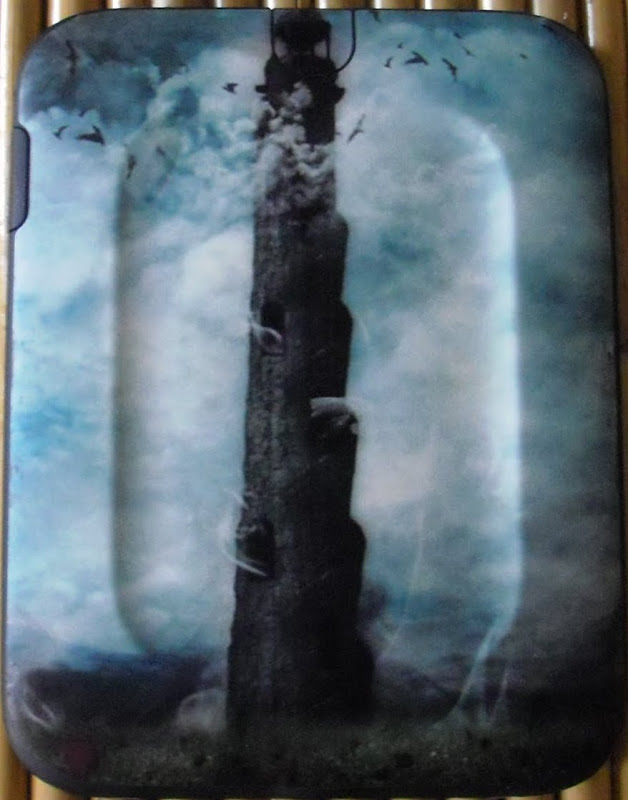
I got it on Wednesday, and I love it. My new Nook is wearing custom Dark Tower Gelaskin, which is awesome! Easy to customize & order, they shipped quickly, are easy to apply, and they feel great on the device. Not to mention that it looks great all dressed up. :D

The NLT (Nook Lighted Touch - which is what I've been calling mine) is selling for $139 and I think it's well worth the $40 increase over the Nook Touch. Not only for the light, but this one also comes pre-installed with a screen protector with a matte finish, which is usually $19.99 on its own.

I'll admit that the screen has taken a little bit of getting used to for two reasons.
1) The texture. The matte finish makes the touchscreen on the NLT feel quite different from the Nook Touch. It's not as smooth, and initially feels a bit dusty and grainy -- DID NOT LIKE. When I felt the screen for the first time, I immediately drove to B&N to get a screen protector to put on it, and was dismayed to find a big red warning on the package saying NOT to use it on the NLT, that it would damage it. I almost considered returning it because I didn't like the feel that much. But I wiped it down with a soft cloth and I admit that after using it for the last couple days the grainy feel has improved quite a bit, and no longer bothers me nearly as much. And I think I'm pretty picky.

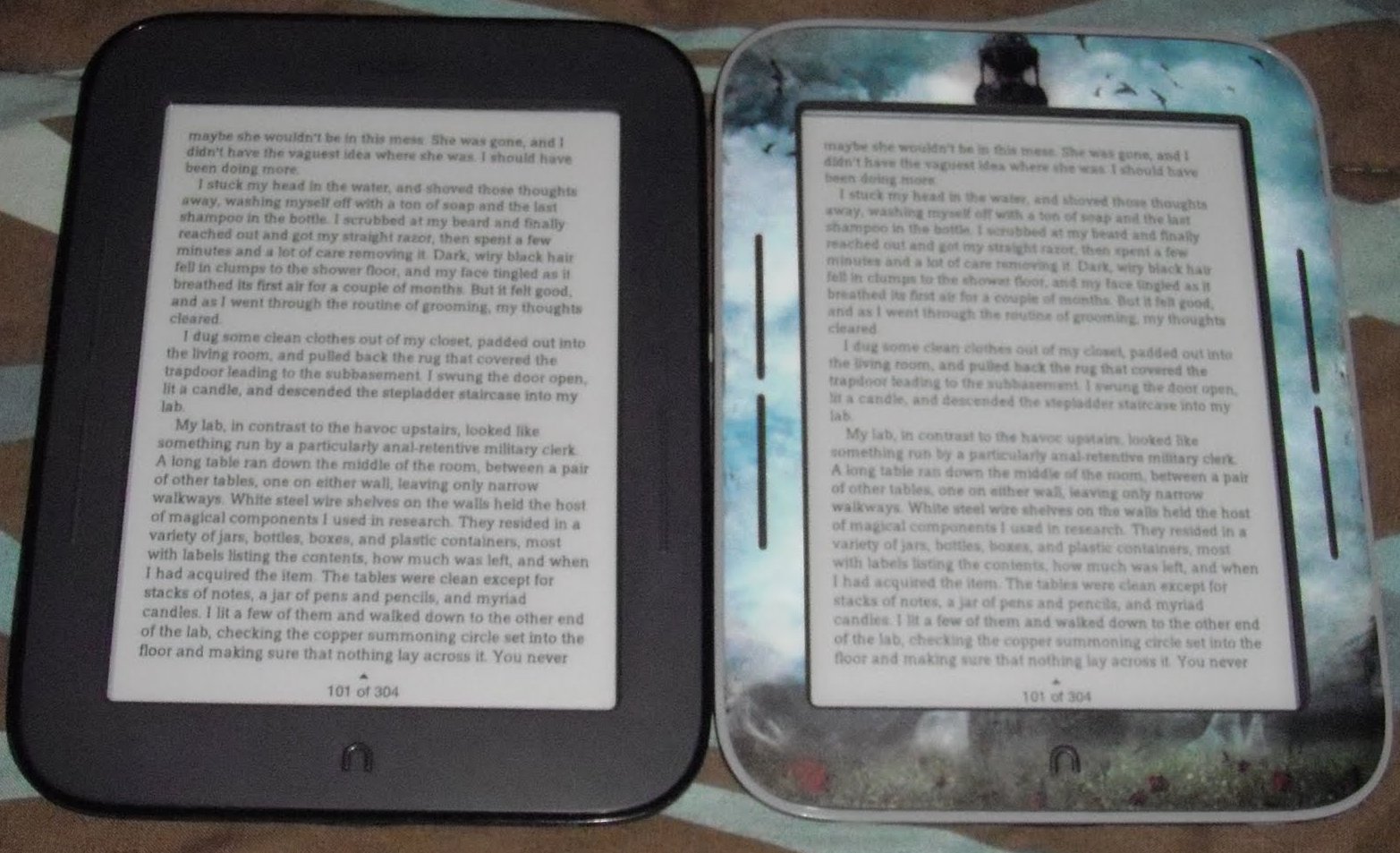
2) The font appears slightly lighter. It's just as crisp and clear, but it's lighter on the grey-scale than the font on the Nook Touch. I believe that this is also due to the matte finish. Here's a picture to compare.

I apologize for the blurriness... I really need a better camera!
But, you can see how the font on the Nook on the right is just slightly lighter than the one on left.
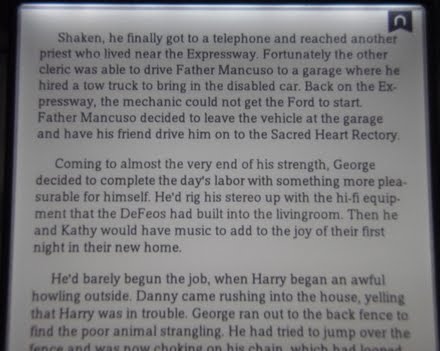
I really don't notice a difference while reading. It's only when looking at them side by side like this that I can even tell. Here's another example, that's maybe better (my camera really doesn't like focusing on words!).

The black in the image on the left is more of a dark grey on the right.
(Flash was on in this pic)
OK, so about the backlight. This is the whole point, right? Yeah. I really like it. It's not 100% uniformly even across the whole screen, but I'd say it's like 95%, which is much better than any separate reading light can do. There's 8 LED lights across the top, and directly underneath them is a strip of bright light, and then right under that it dims a bit, and then evens out:

This is about 25% brightness in a completely dark room.
Again, I honestly stop noticing this while reading - it's only slightly dimmer, and perfectly readable. The light is adjustable, and at some brightnesses the unevenness is more noticeable than others. I've tried it with a variety of settings, and I think I like it best at around 25% brightness. Even that is plenty bright enough to read by in pretty much all settings. In bright background light, it just lightens up the background display for a little contrast, but in dark settings it's quite bright. 100% brightness is VERY bright. It's almost bright enough to use as a reading light for another reader!

Wasn't kidding. O_o
Anyway - I love it. If you're in the market for an e-reader, I would absolutely recommend this one. Little clip on lights can't hold a candle to the backlit e-ink display. No glare, no unreadable dim spots and adjustable.

Good job B&N! :D

For those of you curious - here are front and back images of the Gelaskin:


Sunday, April 29, 2012

Review: The Wind Through The Keyhole by Stephen King ★★★★

The Wind Through the Keyhole (The Dark Tower, #4.5)3.5 Stars
Believe it or not, there was a time when I hadn't read the Dark Tower series... but we don't talk about that. It's a painful time in my history, and polite company lets me keep my shame to myself. But I mention it because since stepping foot into the Tower multiverse, everything changed. I thought I was a Stephen King fan until I read the Dark Tower series, but I had no idea how much I could love King and his books. I adore this series. No other series or book can claim a higher spot in my heart (not even Harry Potter, though that's a very close second), so when I learned that there would be a new book in the series, I SQUEE'd all over the damn place. Messy clean-up, but so worth it.

Dark Tower is bittersweet. It is. But that's one of my favorite things about King; he makes it real. So I couldn't wait, nay... COULD. NOT. WAIT. to read the shit out of this book and finally see the ka-tet again. To go on another adventure with them, to see what this new interlude holds... despite knowing ka-shume is coming down the path of the beam for them. But then... I admit to feeling a bit cheated after I started. Maybe that's not fair, probably not, because had I read the book description, I'd have known that likely wasn't going to be what I'd get... But those of you who know me well, those who share my khef, do it please ya, will know that I wouldn't want to know, that I'd want to just go where Ka's wind blows. And so I did... but I can't help wanting more of Roland, Eddie, Susannah, Jake, and Oy.

As a ka-tet book, low marks for this one because there's just so little of them here... but as a Mid-World/multiverse book, high marks, because there's a lot here in that regard, and it's quite interesting to piece together.

What we have here is a story within a story within a story. Not my favorite thing. I love Wizard and Glass, but the Mejis flashback storyline is long. W&G is my least favorite of the series for this reason, and I always get to a point where I'm ready for the Young Roland story to be done so I can get back to Present Roland. But saying it's my least favorite is not saying much, because every book in the series is fantastic in its own way.

So coming on the heels of Wizard and Glass, in internal story setting order, is The Wind Through the Keyhole, where our ka-tet takes shelter from a starkblast and has another episode from Roland's seemingly endless cache of Adventure Stories From My Youth and Other Relevant Tales from Before The World Moved On.

The first story Roland tells is of being sent on another mission by his father to take care of what's rumored to be a Skin-Man (a shapeshifter) terrorizing one of the baronies. Within this story is the story from which this book takes its title, which is the story of Tim Ross and his encounter with the Covenant Man, whose horse is called Blackie. Just sayin'. This story ties into both the Young Roland story, and the Present Roland story... in different ways, which was interesting.

These two stories make up the bulk of the book, which is short (for King) to begin with. But these are interesting, particularly Tim's The Wind Through The Keyhole, because of how other multiverse books might, and probably do, connect with it. I counted quite a few references to other books in the three stories, including Eyes of the Dragon, The Talisman, and Desperation, just to name a few.

I won't go into much more detail, since everyone should read it for themselves. Overall for me, this was worth the read, although my heart still wanted more of Roland, Eddie, Susannah, Jake, and Oy. Maybe... Maybe Gan will bless King with another Dark Tower book?

A girl can dream...

Monday, April 16, 2012

Author Interview: Jolene Perry, Author of Night Sky

After losing Sarah, the friend he’s loved, to some other guy, Jameson meets Sky. Her Native American roots, fluid movements, and need for brutal honesty become addictive fast. This is good. Jameson needs distraction – his dad leaves for another woman, his mom’s walking around like a zombie, and Sarah’s new boyfriend can’t keep his hands off of her.

As he spends time with Sky and learns about her village, her totems, and her friends with drums - she's way more than distraction. Jameson's falling for her fast.

But Sky’s need for honesty somehow doesn’t extend to her life story – and Jameson just may need more than his new girl to keep him distracted from the disaster of his senior year.

Interview:


Jolene Perry is the author of Night Sky. Jolene grew up in Wasilla, Alaska. She graduated from Southern Utah University with a degree in political science and French, which she used to teach math to middle schoolers.

After living in Washington, Utah and Las Vegas, she now resides in Alaska with her husband, and two children. Aside from writing, Jolene sews, plays the guitar, sings when forced, and spends as much time outside as possible.

She is also the author of The Next Door Boys and the upcoming Knee Deep.

Q: Can you give a description of what the book is about in 5 words or less?
A: Boy. Girl. Mess. Another girl.

Q:  What about Night Sky do you think would appeal to those who are not Young Adult contemporary romance readers?
A: Jameson was a blast to write. I love that it took place in Las Vegas, and the bits of Sky's heritage were also a lot of fun. The thread of honesty weaves throughout - something that could be a part of any type of fiction.

Q: What is your favorite aspect of Native American culture?
A: Mostly the idea that we're all part of something a lot bigger than ourselves. I love people who are connected to the beliefs and the traditions of their families who are long gone.

Q: Jameson seems to have a lot of changes going on in his life - what advice would you give a teen going through something similar?
A: No matter how crappy life seems, it'll get better. We have a hard time seeing outside of what's happening in our lives at any given moment, but when we can, no matter what's happening now, will seem a little better.

Q: What is your favorite thing about being a writer?
A: That my hobby is my job, AND that I get to tell stories all day.

Q: Is there any particular message or theme that you hope someone would take away from Night Sky?
A: I love the idea that when people are really, truly, honest with each other, it can be a lot more exciting than being secretive.

Q:  If you could be a character in any book, which character would you be, and why?
A: This is a hard question to answer, because in a way, I get to be each person that I write, so I feel like I spend a lot of time in other people's shoes. The other thing is that stories tend to be real life, only with more drama. I honestly have enough drama, and prefer to be me. Kind of boring, but true.

Thanks so much for giving me the chance to be here today!!

~ Jolene

Where To Find Night Sky:

Purchase Links: For Your Kindle | For Your Nook | From Smashwords | PDF
eBook
ISBN: 9780983741862
ISBN: 9781466052338
Pages: 247
Release: March 1, 2012 

Friday, April 13, 2012

Ready Player One by Ernest Cline ★★★

Ready Player OneReady Player One by Ernest Cline
My rating: 3 of 5 stars
You know that thing, the thing that everyone else thinks makes you the nerdiest nerd to ever nerd? That thing is what this book is all about, and it's awesome.

Mostly awesome.

This book celebrates the geekdom of the 80s. The music, the movies, the books, but especially the games and technology. Because the 80s were full to the gills of new technology that allowed games to move from boards to computers and game consoles. It allowed awesomeness like this to exist:

--------------------------------------
Announcer: Are you tired of dad?
Boy: Dad, no one wants to hear your stupid Vietnam stories!
Announcer: Are you tired of mom?
Mom: Hi angel, do you want to read a book or go outside?
Boy: No!

(Degenatron!)

Announcer: The arcade comes to your living room, only without the creepy guys offering to show you puppies.
Boys: Awesome!
Announcer: With the Degenatron, you can play video games just like you are in the arcade!
Kids: Excellent!

(Degenatron!)

Announcer: The Degenatron gaming system plays three exciting games including Defender of the Faith where you save the green dots with your fantastic flying red square.
Boys: Cool!
Announcer: Monkey's Paradise where you swing from green dot to green dot with your red square monkey.
Boys: That's rad!
Announcer: And Penatrator where you smash the green dots deep inside the mysterious red square.
Boys: WOW!
Announcer: The Degenatron brings arcade realism to your living room. It can even take quarters and a strange sweaty man comes by to empty the machine on Fridays.

(Degenatron!)

Announcer: Degenatron, fighting the evil of boredom.

Boys: I'll never go to school again!

(Degenatron!)
--------------------------------------
If you're not familiar with this, it's a fake commercial played on one of Grand Theft Auto: Vice City's in-game radio stations. GTA Vice City is set in 1986, and there are tons of references contained therein... Mostly of the 'did-they-really-just-say-that?' variety. The one above is a reference to the awful graphics of 80s computer and console games, and the creepy guys usually found around arcades. Speaking of which, anyone looking for a puppy? I know a guy...

Anyway. This book is exactly what GTA:VC isn't. It doesn't make fun of the atrocious 80s... it celebrates it. It celebrates the huge amount of innovation and change that occurred in that decade, and the huge amount of geekdom that fueled those changes. This book celebrates all that the D&D players have always dreamed... that they can do exactly what they love and hit it big by doing so.

That's what James Halliday did. He took his love of 80s pop culture and made it into the Moste Epice Queste EVAR before he died. He created the world's first truly immersive virtual reality game and free education system that is as vast as imagination itself, The Oasis, and promised to leave it and his megabillions (really) to the first person who successfully completes his quest: Find 3 keys, go through their respective gates, and then find the egg.

Enter 'Parzival' aka Wade Watts, 18 year old orphan (does one still count as an orphan once they've hit their majority?) who is obsessed with finding the egg and winning the ultimate prize. But maybe more than the desire to win is the desire to prevent the Sixers from winning. The Sixers are employees of The Oasis's rival corporation, who would love nothing more to win the Oasis cash cow and then start milking it dry. Instead of free use (services, such as transportation, is paid for in the Oasis, but logging in is free), there'd be a monthly fee, higher fees for everything and ads galore, which in the hard times of economic collapse shown in the book would reduce the availability to only those rich enough to pay. In other words, they'd ruin the only sanctuary that millions of people have from their hard day to day lives.

The first 3rd of this book was AWESOME. The parts of the book pertaining to quest and battles were awesome. The concept and the detailing and the story was all awesome. There were some parts that were so exciting I couldn't put the book down, but then there were others that were a bit frustrating or (dare I say it?) boring. So brace yourselves... I'm about to start inventorying my complaints.

This book seemed to go in waves. Something thrilling would happen, and then it would shift to very not thrilling. Then after a while, it'd start to build momentum again, and then the same thing again. So it was a little hard to keep my interest going the whole time, because I don't think that I need to know every single detail of the components of Wade's apartment or his gear for logging in and using The Oasis. I don't know what any of it means anyway, though I can guess it's pretty cool. It just got a little tedious and I got impatient to get back to the quest.

Likewise with the romance. Let me just say up front that I know Wade is 18, and has never really interacted with girls before, let alone an awesomely popular famous hottie girl who just HAPPENS to have all of his same interests and hobbies and whatnot in common with him, so I know it is unfair and unrealistic of me to get irritated by the romance element to this story... but I did. I just didn't much care. Just ONCE I'd like to read a story with a young adult protagonist that doesn't have a romantic theme, or at least not an insta-love one. It just got a little tedious and I got impatient to get back to the quest... again.

Then, the dialog. Oh goodness. It was awkward. It FELT awkward. Too forced and too "hip" and too everything, especially Aech's slang, and it felt fake. Didn't work for me there.

Finally, we come to the issue of death. I feel like the way death was portrayed in this book was somewhat ridiculous. First, let me say that there were two kinds of death: avatar death and real world death. Avatar death means that your Oasis character dies, you lose all your stuff (status, inventory, credits/money), and you start over from no0b status. Real world death means you, the person who exists in the real world, actually die, for realzies, no do-overs, no resets, no reloads, you're just dead. D-E-D, dead, as my daddy would say.

Now, there were a couple of RW deaths, and it was one of these where I couldn't put the book down. It was crazy intense and I just had to know what was gonna happen next. But for all the intensity, it didn't seem to register much on Wade's "Oh Shit!" scale, at least not when it came to avatar death. There's a scene where a big battle is going down, and avatars are rushing in to do battle without hesitation, knowing that it could mean their death, and it was portrayed as really brave and harrowing. And I wondered to myself... So what? Why the dire reaction? It's just some data in a server somewhere that would be zeroed out and that person could create a new one. It's not a real life-or-death situation, so I don't really feel like it was all that brave.

But then on the other side of the coin is the fact that the bad guys could go after Oasis players and Real World kill them. Yet at the end, there's no tension around this possibility, because deus ex machina arrived to provide the way, or it was just conveniently forgotten that the real world existed in the heat of battle... or probably both.

So... While I really did enjoy this one, obviously I had some pretty large issues with it. It was a fun story, and I have already recommended it to a few of my friends that I think would enjoy it, but I admit that I wish I'd enjoyed it even more than I did.

I'm very curious to see where Cline goes from here though. I'd definitely pick up his next book, and in the end, that's really all that matters, isn't it?

View all my reviews

Friday, March 23, 2012

FFR (20): The Painted Darkness by Brian James Freeman ★★★★

Friday Flashback is hosted by Jen @ The Introverted Reader.

Originally Reviewed: September 5, 2011
This was not at all what I expected. I have had this on my "to read" list for a while, and I'm glad that I read it, because I enjoyed it, quite a lot. This is one of those books that I think people will either really like, or just feel kind of 'meh' about. I think that there were a couple things here that really worked for me.

The Painted DarknessOne of those things is that I have a bit of creation fascination. I am not a creative person really. I have my moments where something will just click, but I have total creation envy for authors and artists and other people who make something out of nothing, especially when the process is an escape from themselves and the world, or maybe an involuntary need to express something. Those kind of compulsory drives to get it out are fascinating to me. And I liked seeing how that was portrayed here.

Another one of those things is the way the story was told, alternating between young Henry and present day adult Henry. I thought that this format worked well. The pacing was just right to keep me interested (and I admit that I was slightly more interested in the Young Henry sections than the Adult Henry ones), and I thought that the tone of the story was excellent. Atmospheric and creepy, while keeping a sense of realism even when things leave realism behind. This wasn't a Shock & Gore story, this was a ...something's just... not... quite... right... story. And I liked it for that. Because it made me think, and wonder, and guess, and I love when stories can do that, and draw me into them and make me care about the characters - or, in this case, character, singular.

This story will stick with me for a while, and even in the process of writing this review, I've been turning it over in my mind and drawing new conclusions and thinking of things in a different way, and I'm liking it even more now because of that.

And, I think I'll just leave it at that.

Sunday, March 11, 2012

Review: The Lions of Al-Rassan by Guy Gavriel Kay ★★★

The Lions of Al-RassanThis book has come highly recommended by almost all of my friends, and so naturally, I was very excited to read it. This was my first experience with Kay, and the consensus seems to be that this is his best work. Certainly the Goodreads average rating bears that up. Lions of Al-Rassan currently has a an average rating of 4.27 of 5. Pretty impressive, and the highest of all of his books.

It just didn't quite get there for me. Maybe it was the expectation of greatness that let me down, but I don't know. Maybe the fact that I don't have much knowledge of the history of the Iberian peninsula, but again, I don't think so. By all accounts, it's not really necessary to have external knowledge prior to reading Lions. It's not that this was bad, or that I didn't like it... In fact I'm having a hard time putting my finger on just how I'm feeling about it, now that I'm finished. On the one hand, I liked it quite a bit, but on the other, I felt like there was just something missing or off about it, and I had several issues that I can't ignore.

So this is going to be something of an itemized review...

Characters: This was by far my favorite thing about this book. I am a character reader, and I need characters that I can identify with in order to enjoy a story. This one was full of brilliantly real characters. There was quite a cast, as shown by the full character list at the beginning of the book, but I never felt confused by who was who. I loved the four main characters: Ammar, Rodrigo, Jehane and Alvar. (I also loved Rodrigo's wife Miranda, who was awesomely bad-ass. I would have loved to see much more of her.)

Ammar and Rodrigo kind of represent their people and cultures in the book, although not well at all. Most of their respective cultures are caricatures of pious intolerance and hatred, whereas Ammar and Rodrigo are both good, honorable, and open-minded men, who are willing to accept and trust based on character, not purely on belief in the "right" god. So while Ammar is an Asharite and Rodrigo is a Jaddite, they still find a way to work together.

There were quite a few emotional moments while reading this, and though I feel like they could have been better written (which I will get to in a bit), I still felt for the characters and the things that happened to them. I did feel like some of the follow-up with some characters left something to be desired, but the characters themselves were well done and fleshed out and real.

Worldbuilding: The worldbuilding here was one of the aspects that I struggled with the most. At times it was overwhelming in the amount of information given at once, but still I felt like there was still more I wanted to know. There were places named that we never got to see, but were clearly important to the history, like Aljais, or Soriyya. The descriptions were gorgeous, and I could see everything clearly, but I wanted to know more about the places that were important but never shown.

Religion: The religious aspects of this book were well done, and the dividing lines between the three different religious groups were drawn clearly, but I wanted to know more about what each believed in, not just who they hated and wanted dead because they believed in something different.

Not knowing what they actually believed in, it was hard for me to identify with either the Asharites' or the Jaddites' beliefs. Are these gods so bloodthirsty that the only valid form of worship is saying that you do and then killing those that don't? Was there no other form of worship? The Asharites abstain from alcohol, but unless I missed it, I don't see anything at all that differentiates them other than the name of the god they worship and whether or not they'll have some wine with dinner.

The Kindath were different though. I don't know much about their beliefs either, but it seems to me that they were to be equated with Jews, at least in the way that they were treated and persecuted. They at least seemed peaceful, wanting nothing more than a place to live peacefully. This apparently equates to baby-killing monsters to the bloodthirsty Asharjaddites, who both hate the Kindath. Because who better to persecute than the people who aren't allowed weapons? That being said... it was realistic and believable that different religious sects would want to kill each other. Not logical, but religious belief rarely is.

Writing: For the most part, I liked the writing. I thought that it was readable and in general, the prose was beautiful. There were some unexpectedly funny parts, and overall I liked it.

But I did have a big problem with the writing in one aspect, which was that anytime there was a moment of suspense, Kay would write the scenes in such a way as to draw it out to unnatural lengths. For instance, the one that bothered me the most was a scene in which a character died. For nine pages, we were left wondering who it was, theorizing, trying to determine who it could be. By the time the name was finally given (and it was an unexpected one), I was more annoyed with the delay tactics and manipulation than I was distressed about the character's death. I was upset about the death, but it was kind of overshadowed by a feeling that I was being manipulated. I felt that it cheapened the loss, and took away from the emotional impact it should have had. This was done in different ways and in different situations all throughout the book, and it was incredibly frustrating.

Another issue that I had was Kay's tendency to skip action, and then tell us about it later. I can sort of understand the decision for doing this. It allowed him to not only tell us what happened in condensed form, but gave us insight into some of the characters as well. I just didn't like it. I want to see the action. I want to be part of the story, not an outsider being filled in on the details later.

Pacing & Plot: At around the 75% mark, I started wondering where this story was going and how it would possibly be resolved in the remaining pages. We've been with these characters for a while, and there's been a lot of build-up and pieces moving into position, little battles and maneuverings, but nothing has really happened yet. The huge campaign to reconquer the disparate peninsula lands and reunite them into one large kingdom of Esperana hasn't even started. Of course, the epilogue sorts out what happened and fills us in on the important details. All the build-up and then the climax felt rushed and almost like an afterthought. Disappointing.

I wanted to love this book. Maybe if I'd read it before reading some of the amazing epic fantasy I've read in the last year, I would have. But the writing here just felt like it got in the way of the story. Yes, it was beautifully written at times, but the need to be mysterious and drag out the suspense, and circle back to tell us about the action or important events rather than just showing them to us to begin with really didn't work for me.

TL;DR Review: I liked it, but thought parts could have been better.