Showing posts with label sci-fi. Show all posts

Saturday, April 6, 2013

Review: Closure, Limited by Max Brooks ★★★★

I really enjoy Max Brooks' stories. I love his insightful way of looking at the zombie culture, what it represents, what it means for us, what we would, or could, do about it if it were to occur.

I recently recommended Max's World War Z to a friend, and loaned him my copy so he could read it. (Don't worry, it's back in my possession now, and unharmed. :D) He returned it with the comment that it was probably one of the best stories about society in crisis he'd ever read, and that the realism was incredible. I completely agree, which is why I recommended it to him in the first place. ;)

So anyway, my point in mentioning this is that Max Brooks' books have been on my mind recently, and so when I was browsing Audible last night looking for something to listen to so I could clean the kitchen (What? Like you don't...), I discovered Closure Limited. I'd never heard of it before, so I was kinda excited by the thought of new material.

So, I downloaded, listened, and cleaned... in that order. Priorities, people. O_o

Overall, I liked this - maybe not AS much as Zombie Survival Guide or World War Z, but close. I think part of what detracted from this a bit was the format and the reading. For one thing, the reader sounded a lot like Max Brooks himself to me. I have heard Max read on the WWZ audiobook (the abridged one - I've yet to listen to the newer unabridged version), and I've seen him on that one zombie documentary show that I can't think of the name of... *IMDBs* "Zombies: A Living History". So for the intro, the reader's voice worked fine for me... but in the stories themselves... it wasn't the best match.

That's not to say that the performance wasn't good... It was good, but I am kinda picky when it comes to audiobook readers, and I wouldn't say that Christopher Ragland is among my favorites. The male voices were OK - but the females were... not. And three times he had to do accents: one from The Netherlands (if I remember right?), another from Vietnam, and then a woman from China. Oddly, the Chinese woman's voice distracted me the least, which was kind of contradictory to how I felt about how he read other women - maybe it was the more staccato way in which he read her that helped. Not sure.

Before I talk about the individual stories, I'll just mention one other thing that detracted from this book for me, with regards to the audio version. That issue is that each story is headed by a chapter. "Chapter One: Closure, Limited". I didn't actually NOTICE this, though, until midway through the 2nd story, when I was wondering what the hell the events I was listening to had to do with where I thought the story was going. I'm used to stories jumping around at chapter breaks. It gives a different perspective, and progresses the story, etc, so I heard, "Chapter Two: Steve & Fred" and didn't think anything of it being a NEW story, but a 2nd chapter in the story I was listening to already.

It was a little distracting, the be honest. Probably in print form, this wouldn't be an issue, because I'd know, getting to the next story, that it's not really "Chapter Two". Anyway, so when I eventually realized that it was a different story, it made a LOT more sense.

Moving on to the stories themselves, I really enjoyed them.

Closure, Limited:
Think about a zombie apocalypse... You know that the undead are everywhere, and that they are relentless killing, and turning, machines. Think about your loved ones, the ones that are now out of contact with you in your safehouse, or compound, or whatever. You don't know whether they are alive or dead or undead. You hope that they are alive, but the odds are... slim. After a while, the wondering starts to get to you... it starts to be harder to live with NOT knowing than it would be to just mourn. That's where Closure, Limited comes in - they allow you to end that uncertainty. They provide a service that gives just what their name says: closure. Granted, there's a certain amount of self-deception that's required, because, after all, you HIRED this company to give you closure... but if you just need the symbolic aspect, you're all set.

This one really made me think... It is kind of awful in its way, and extremely risky, but could I really say that I wouldn't want something like this to exist if I was in the situation of needing it? At the very least, it would be cathartic to destroy the hope that just stubbornly hangs on and insists on tormenting us...

Steve & Fred:
When I listened to this one last night, I was... not impressed. It didn't help that I didn't realize it was a new story (as I mentioned above), but to add to that the story also has a shift of its own. So, to be fair, I listened to this one again this morning, and I've changed my initial opinion. This is a GOOD story. It's like a little polaroid of a story, one that is still working on developing toward the middle. There's not much to this one - it's 22 minutes long, so, maybe I'd estimate a similar number of pages if the reader goes through 1 per minute. Maybe double if he reads slower. I dunno. But either way, the way it expands to show the whole situation is impressive, and enormous in its capacity for dread. And the irony of the story-within-a-story aspect is not lost on me. This is good stuff. 

The Extinction Parade:
This one is probably my least favorite of the lot, and oddly enough for the "unreality" of this zombie story containing vampires. Yes. Really. 

I mean, it's not that I'm against vampires and zombies in the same story; in fact, usually I'm good with that. But in Max Brooks' universe, zombies invade the normal, everyday world due to a virus. There's nothing paranormal about them. So the insertion of the paranormal here just felt... out of place. 

That being said, if I put that aside, the story is still a good one. It brings to light the concept of resources - that if suddenly a previously thought continually renewable resource suddenly starts to dwindle, would those who rely on the resource notice in time to stop it... COULD they stop it even if they did? 

The Great Wall: 
This story, previous to my re-listen to Steve & Fred, was my favorite of the four. Now, I'd say they are tied. I loved this story for everything that it represented in terms of human resilience and stoicism and courage. It brought tears to my eyes, both of pride and sadness, and I loved every second of it. 

This one is definitely a keeper for anyone who enjoys zombie lit, or who is a fan of Max Brooks, or both. I definitely recommend it. 

Friday, April 13, 2012

Ready Player One by Ernest Cline ★★★

Ready Player OneReady Player One by Ernest Cline
My rating: 3 of 5 stars
You know that thing, the thing that everyone else thinks makes you the nerdiest nerd to ever nerd? That thing is what this book is all about, and it's awesome.

Mostly awesome.

This book celebrates the geekdom of the 80s. The music, the movies, the books, but especially the games and technology. Because the 80s were full to the gills of new technology that allowed games to move from boards to computers and game consoles. It allowed awesomeness like this to exist:

--------------------------------------
Announcer: Are you tired of dad?
Boy: Dad, no one wants to hear your stupid Vietnam stories!
Announcer: Are you tired of mom?
Mom: Hi angel, do you want to read a book or go outside?
Boy: No!

(Degenatron!)

Announcer: The arcade comes to your living room, only without the creepy guys offering to show you puppies.
Boys: Awesome!
Announcer: With the Degenatron, you can play video games just like you are in the arcade!
Kids: Excellent!

(Degenatron!)

Announcer: The Degenatron gaming system plays three exciting games including Defender of the Faith where you save the green dots with your fantastic flying red square.
Boys: Cool!
Announcer: Monkey's Paradise where you swing from green dot to green dot with your red square monkey.
Boys: That's rad!
Announcer: And Penatrator where you smash the green dots deep inside the mysterious red square.
Boys: WOW!
Announcer: The Degenatron brings arcade realism to your living room. It can even take quarters and a strange sweaty man comes by to empty the machine on Fridays.

(Degenatron!)

Announcer: Degenatron, fighting the evil of boredom.

Boys: I'll never go to school again!

(Degenatron!)
--------------------------------------
If you're not familiar with this, it's a fake commercial played on one of Grand Theft Auto: Vice City's in-game radio stations. GTA Vice City is set in 1986, and there are tons of references contained therein... Mostly of the 'did-they-really-just-say-that?' variety. The one above is a reference to the awful graphics of 80s computer and console games, and the creepy guys usually found around arcades. Speaking of which, anyone looking for a puppy? I know a guy...

Anyway. This book is exactly what GTA:VC isn't. It doesn't make fun of the atrocious 80s... it celebrates it. It celebrates the huge amount of innovation and change that occurred in that decade, and the huge amount of geekdom that fueled those changes. This book celebrates all that the D&D players have always dreamed... that they can do exactly what they love and hit it big by doing so.

That's what James Halliday did. He took his love of 80s pop culture and made it into the Moste Epice Queste EVAR before he died. He created the world's first truly immersive virtual reality game and free education system that is as vast as imagination itself, The Oasis, and promised to leave it and his megabillions (really) to the first person who successfully completes his quest: Find 3 keys, go through their respective gates, and then find the egg.

Enter 'Parzival' aka Wade Watts, 18 year old orphan (does one still count as an orphan once they've hit their majority?) who is obsessed with finding the egg and winning the ultimate prize. But maybe more than the desire to win is the desire to prevent the Sixers from winning. The Sixers are employees of The Oasis's rival corporation, who would love nothing more to win the Oasis cash cow and then start milking it dry. Instead of free use (services, such as transportation, is paid for in the Oasis, but logging in is free), there'd be a monthly fee, higher fees for everything and ads galore, which in the hard times of economic collapse shown in the book would reduce the availability to only those rich enough to pay. In other words, they'd ruin the only sanctuary that millions of people have from their hard day to day lives.

The first 3rd of this book was AWESOME. The parts of the book pertaining to quest and battles were awesome. The concept and the detailing and the story was all awesome. There were some parts that were so exciting I couldn't put the book down, but then there were others that were a bit frustrating or (dare I say it?) boring. So brace yourselves... I'm about to start inventorying my complaints.

This book seemed to go in waves. Something thrilling would happen, and then it would shift to very not thrilling. Then after a while, it'd start to build momentum again, and then the same thing again. So it was a little hard to keep my interest going the whole time, because I don't think that I need to know every single detail of the components of Wade's apartment or his gear for logging in and using The Oasis. I don't know what any of it means anyway, though I can guess it's pretty cool. It just got a little tedious and I got impatient to get back to the quest.

Likewise with the romance. Let me just say up front that I know Wade is 18, and has never really interacted with girls before, let alone an awesomely popular famous hottie girl who just HAPPENS to have all of his same interests and hobbies and whatnot in common with him, so I know it is unfair and unrealistic of me to get irritated by the romance element to this story... but I did. I just didn't much care. Just ONCE I'd like to read a story with a young adult protagonist that doesn't have a romantic theme, or at least not an insta-love one. It just got a little tedious and I got impatient to get back to the quest... again.

Then, the dialog. Oh goodness. It was awkward. It FELT awkward. Too forced and too "hip" and too everything, especially Aech's slang, and it felt fake. Didn't work for me there.

Finally, we come to the issue of death. I feel like the way death was portrayed in this book was somewhat ridiculous. First, let me say that there were two kinds of death: avatar death and real world death. Avatar death means that your Oasis character dies, you lose all your stuff (status, inventory, credits/money), and you start over from no0b status. Real world death means you, the person who exists in the real world, actually die, for realzies, no do-overs, no resets, no reloads, you're just dead. D-E-D, dead, as my daddy would say.

Now, there were a couple of RW deaths, and it was one of these where I couldn't put the book down. It was crazy intense and I just had to know what was gonna happen next. But for all the intensity, it didn't seem to register much on Wade's "Oh Shit!" scale, at least not when it came to avatar death. There's a scene where a big battle is going down, and avatars are rushing in to do battle without hesitation, knowing that it could mean their death, and it was portrayed as really brave and harrowing. And I wondered to myself... So what? Why the dire reaction? It's just some data in a server somewhere that would be zeroed out and that person could create a new one. It's not a real life-or-death situation, so I don't really feel like it was all that brave.

But then on the other side of the coin is the fact that the bad guys could go after Oasis players and Real World kill them. Yet at the end, there's no tension around this possibility, because deus ex machina arrived to provide the way, or it was just conveniently forgotten that the real world existed in the heat of battle... or probably both.

So... While I really did enjoy this one, obviously I had some pretty large issues with it. It was a fun story, and I have already recommended it to a few of my friends that I think would enjoy it, but I admit that I wish I'd enjoyed it even more than I did.

I'm very curious to see where Cline goes from here though. I'd definitely pick up his next book, and in the end, that's really all that matters, isn't it?

View all my reviews

Friday, March 30, 2012

Review: Leviathan Wakes by James S.A. Corey ★★★★★

Leviathan Wakes (Expanse, #1)Confession Time: I'm very bad at categorizing genres and sub-genres, so it didn't dawn on me that Leviathan Wakes would be considered a "space opera" until I saw it in the genre listing on the book's Goodreads page. I still don't really know what that is (space opera, not a Goodreads page), despite having read the Wikipedia page and stuff. I think of "space opera" and this comes to mind:

Probably not the same thing.

But I did realize that my last attempt at reading a "space opera", The Warrior's Apprentice, left me distinctly underwhelmed.

So, if not for Audible, this book was probably a Lifer. By that I mean a book that will just sit on my radar forever, but never actually get picked up and read -- at least not for a long, long time. I have lots of these, unfortunately. There are just too many books, and too little time in the day. (If only my job would stop being so insistent that I show up!)

How did Audible, that evil (MWAHAHAHA!) Amazon company, factor in you ask? Well, not only did they give me a $10.00 credit for my 1 year anniversary of having an account with them (woohoo! free money!), but then they also put this audiobook on sale for $4.95. So Audible bought me this audiobook. And it rocked. Thanks, Audible!

So let's get down to business and talk about how much I loved this book.


Wait, wait... no... I was right before. This much:


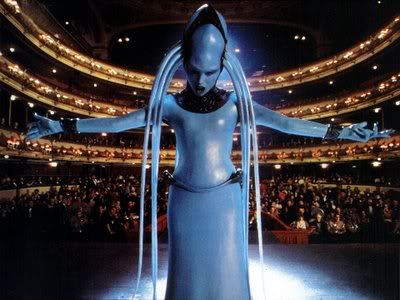
Because I loved The Fifth Element, and I loved Leviathan Wakes.

This book had everything. Great, believable, and realistic characters, an interesting plot, fantastic scope and worldbuilding, just the right amount of plausibility to make it terrifying, brilliant humor that was perfectly timed and hit just the right notes to make me laugh out loud, and it had what were awesomely called 'vomit zombies'.

In fact, the only thing I can find to criticize, and it's more of a nitpick, is the overabundance of saids peppering the narrative. Holden said, Miller said, Naomi said, Fred said, Amos said, etc etc etc. Listening to the many saids being read was a little tedious, but only occasionally; it was mainly noticeable during long stretches of pure dialogue.

Otherwise, I loved everything about this book, and the reading. The reader did a great job at letting the story do the talking, and despite only getting to listen to this in small chunks at a time, I was engrossed in the story.

I loved the characters, and especially enjoyed the way that the two main characters, Holden and Miller, interacted with each other. They are from different sides of the personality spectrum, with two completely different ways of handling a situation, but when the shit (or the zombie vomit) hits the fan, they effortlessly slip into "Let's discuss this when we aren't dead" mode, and just kick ass. I loved it. I thought they complemented each other wonderfully, and the arc of their working relationship was realistic and understandable, from both sides.

Which brings me to the dual narrative. This story is told by alternating viewpoint chapters, and I thought it worked perfectly. We get to see things from two different perspectives, and it allows for so much more story information to be conveyed without huge info-dumps. I liked the noir detective story feel of Miller's chapters, and it contrasted nicely to the more high-tech, adventure feel of Holden's chapters. And then when they run into each other and become a sort of hybrid, I loved that, too.

Speaking of the technology, I thought it was brilliant. We've colonized other planets, and moons, and we can mine ice from Saturn's rings, and travel through space at 7+ Gs. The methods of combating nausea and blackouts during travel at these speeds is interesting, and plausible. The technology that allows us to live on little rocks millions of miles away from the sun is fascinating. But it's still familiar, in a way. RADAR and LADAR are things I've heard of. It's not too much of a stretch to get from where we are now, to where this story shows us in just a few short centuries.

The Protogen project is also plausible, and frankly terrifying, as is the reaction to it. I was totally Team Miller on this one, despite usually landing on Holden's side of the opinional axis. I shudder to think of situations like the ones depicted in this book, and can't help but think that it would happen exactly like this if it were to one day come to pass. I would hope that we've learned from past mistakes... but we don't. This is not-too-distant-future, where we've colonized the solar system, but we're still human. Racism and bigotry is larger scale, because our bodies have adapted to living off-earth, but our minds are still stuck in the 'us vs them' small-town mode, and now we just have more differences to divide us.

But I digress. I loved this book. I loved the world(s), and the characters, and, well, everything. This worked perfectly as a stand-alone novel, but I definitely cannot wait to read more of this series.

Thursday, March 1, 2012

Review: The Man In The High Castle by Philip K. Dick
★★★★

The Man in the High CastlePreface: I chose this book for my very first real life bookclub meeting ever. There was also much drinking (by me) at this meeting, so... if my review is less than coherent, well, actually, I think that's fitting, isn't it?

So, right. I chose this book blindly. Never read PKD before, although I have seen a few of the movies based on his work, and they are all interesting, to say the least. Having just read the amazetastic 11/22/63 by the King, I was in something of an alternate history mindset, and so TMITHC was chosen.

Nerves were on edge while I anxiously awaited the meeting to see what people thought. Hell, to see what I thought, even, because I finished it literally minutes before the meeting. Because I'm a slacker procrastinator who barely started it this week and read 90% of it between last night and today. So, I was pleasantly surprised to find that I enjoyed this quite a lot, even though "enjoy" isn't really the word that comes to mind first... maybe "pondered"? Let's try that one out: "I pondered this quite a lot." Yes. That works. I pondered, and I discovered that I arrived at many more positive feelings than negative, and thus the term "enjoyed" enters into my vocabulary. I'm pleased to announce that my bookclub-mates also arrived at ponder-positive assessments. Bookclub choice #1: Success!

I feel like this is the type of book that begs to be re-read. I don't feel like I really "got" very much of it... or maybe I do/did and I'm
just overthinking it? I don't know. Parts of it really frustrated and unnerved me, and I found myself angrily typing notes on my nook, like how "Lotze can go screw himself the shit" and "yay!! Baynes - show that shit what fear is!" and "seriously?!??!" (These are actual notes that I made while reading. That last one makes sense in context, I promise.). Parts of it were disturbingly unnerving in a "can't look away from the train wreck" kind of way. Fascinating and horrific at the same time.

There were some very interesting concepts in this book, and I thought that PKD did a fantastic job at capturing the different cultural nuances of both the Japanese and Germans. At first I was concerned that I wouldn't like the book because the writing was off-putting. Clipped sentences. No connecting words. Interrupted thought proc--. Then I realized that this was on purpose, after it switched for a bit, and I was actually really impressed. It worked well. The concept of Place was interesting to me, though not because I'd want to live with it. I would be Place-fucked because I can't be bothered to constantly worry about the formality of every single situation. Seriously, who has time to worry about whether the random person on the street is judging you for carrying your own bag, or walking when you could take a cab? Not me. No Place Becky, that's what they'd call me. But hey, at least I know my Place. Zing!

Anyway... I really enjoyed this book, and I'm looking forward to reading more PKD in the future. Yes indeedy. :)


Thursday, February 23, 2012

Bookclub Review: Flowers for Algernon by Daniel Keyes ★★★★

Flowers for AlgernonI have three confessions to make:
1) I never read this book in school.
2) For some reason, this book is associated with the A-bomb in my mind. No idea why.
3) There was beer at my bookclub meeting, and I drank a goodish amount of it, so this review may ramble.

Needless to say, Flowers for Algernon was very, very different than I had always thought. I honestly cannot tell you why I thought that... just that I did. It's just one of those weird association things that people have. Or maybe it's just me. Unsure which.

So, after I read the book description and realized that I was way, way, off, I was actually really looking forward to reading it. I love overcoming adversity type books, I love books that make me feel something, and I love books that make me think. This is definitely one of those, but still I feel like there was something off about it. I liked it, a lot, but I wanted more perspective, I guess.

Quick run-down: Mentally handicapped Charlie is undergoes an experimental operation to increase his capacity for learning and intelligence. The book examines his journey, and what it means, intellectually, socially, emotionally, and morally. Very interesting stuff.

I liked Charlie, more so the less intelligent he was. It was easier for me to sympathize and identify with him then, rather than at the height of his intelligence, when everything and everyone seemed beneath him. I can identify with aspirations and dreams, but I find it hard to understand intelligence so massive that it's alienating. I did like that the more that Charlie learned, the more was able to understand about the world around him, but it was often heartbreaking to see his revelations. Heartbreaking to me, anyway. One of the things that I felt was off about the book was that Charlie seemed distant from his own experiences and memories. He often saw his "handicapped" self in memories as a different person, and his discoveries of memory and experience were like watching something happening to someone else, rather than to himself.

I also wanted more of the history, and more perspective on the story. We see everything through Charlie's eyes, and while this works for most of the story, because we're in his head and we can almost experience his changes directly, some parts just lacked perspective, to me. Particularly the parts dealing with Charlie's incubator mother.There were a lot of parts where Charlie remembered her behavior and her actions and reactions and attitudes, but he couldn't identify with them, or understand them at all. And the reader, seeing through Charlie's eyes, sees the cruelty and the intolerance and impatience, but there isn't anything to give perspective to these memories. We don't see how hard it would be to deal with a young mentally handicapped boy, while caring for a newborn, and constantly worrying that one lapse in vigilance could result in disaster. We don't see how hard day to day life would be with a mentally handicapped 17 year old... we see only the extremes.

Am I condoning her horrific behavior? Absolutely not. Never. But I can put myself in her shoes and imagine just how hard it would be. And knowing myself, and how patience is NOT one of my best qualities, I can understand her frustration and fear and anger. I hope that I would never, ever, ever act on them like she did, that I would have the insight and compassion to accept the hand I'm dealt, should I be put in that position, but I can sympathize... to a point. Past that point and I don't think there's a punishment severe enough to make up for the way she treated her son. Not in a hundred lifetimes. Charlie had every chance to be happy, despite his handicap, and she ruined him.

Forgiveness isn't one of my virtues, either.

I did like the themes in the book, of second chances, at taking a risk, at wanting to better oneself and understand who we are and who we are in the world and what it means to be who we are. I liked the theme of one person being able to make such a difference, such an impact on the world, and it gives me hope that there is a point to it all. I liked the theme of learning to accept the life we have, and that sometimes ignorance is bliss.

Overall, I enjoyed the book, and it definitely was a hit with the bookclub. Very glad that I read this one. :)

Monday, February 13, 2012

Review: The Knife of Never Letting Go by Patrick Ness ★★

The Knife of Never Letting Go (Chaos Walking, #1)I've heard so many great things about this series, and about Patrick Ness in general, that I was very excited to read this series. After reading the prequel, The New World, and his standalone novel A Monster Calls (and adoring it), I was really looking forward to this one. Unfortunately, I find myself disappointed.

Todd lives on New World, which is a relatively new (20 year old) colonization full of people from Earth. In Prentisstown, the settlement where Todd lives, there are no women, and the men hear all the other 164 mens' thoughts, called Noise, constantly. There's no escaping it. He has been taught that the Spackle released a germ that caused the deaths of all the women, and that the same germ caused the Noise, and also allowed animals to talk.

So when Todd finds a quiet patch out near the swamp, everything in his life changes and he's ushered out into the greater, supposedly empty, world with only his dog Manchee to accompany him. Of course he then begins to find out that things aren't exactly the way he'd been told.

Sounds intriguing... but it just didn't work for me...

Friday, November 5, 2010

Friday Flashback Review (10): Little Brother by Cory Doctorow ★★★★

Friday Flashback is hosted by Jen @ The Introverted Reader. 

I originally read this book in March of 2010. 

My review:

Little BrotherI have to admit that the first couple pages or so had me rolling my eyes and wondering if I would be able to actually finish this book. There's so much technoslang that it seemed to me to be trying too hard, even though it is a book about hackers and technokids... Like, "Spending Fridays at school was teh suck anyway, and I was glad of an excuse to make my escape." Teh suck? Really. Ugh. (Although, to be fair, at least he spelled out "suck" and didn't write "teh sux" or something. I probably would have just had to close the book right then and there. *shudder*) Another example is using "vibe" rather than "vibration" when talking about receiving a text message, or "h4wt" for "hot", which doesn't make sense to me anyway, because it's longer and more cumbersome to type "h4wt" than it is to type "hot". But then later, the full and unabbreviated word "tarpaulin" is used rather than just "tarp", which felt out of place considering the shortening/slang usage of other stuff. I don't understand the stupidifying slang netspeak anyway, but then I'm older than 25, so I'm probably a lost cause.

Add to that that there is a lot of hacker exposition and explanation that I didn't really think was necessary, and you have the only two reasons that I couldn't give this 5 stars. I appreciate the author/narrator explaining the technical aspects of the story for those of us who aren't technologically super-savvy like the characters in the book, but it seemed like there was a lot that could have been contextualized (like gait-cams) rather than explained for pages.

But these are small nit-picks. Other than these two things, the book was brilliant, relevant and prophetic. I want to buy copies and hand them out at schools. I want my library to pick up 10 more copies and I want them to just magically appear in people's check-out stacks. I want people to read this book. I want people to learn from it and take away the knowledge that our freedom is more likely to be taken from us by Americans than by anyone else, and to fight against it when it happens.

This book is set in the not-very-distant-at-all future, after a "terrorist" attack in San Francisco, which essentially results in SF being turned into a vicious data-mining police state... Now with even more "With us or against us" mentality per square mile! *Used car salesman smile* It's frightening, because it's already happening right now. Innocent people are being held without trial, without representation, without anything, in the name of "security". This terrifies me more than anything, because there's no limit, no boundary. When there's a nameless, faceless, general "threat", "security" must by necessity become ever more pervasive and intrusive in our lives to find it. And the only people who suffer are us.

Benjamin Franklin said "They who can give up essential liberty to obtain a little temporary safety, deserve neither liberty nor safety." The characters in this book understand this concept and they go about fighting for their freedom and their rights as American citizens even when the people they are fighting are the very people who are supposed to defend their rights as American citizens. Color me proud. Considering that this book is told from the point of view of a 17 year old, I can only hope that REAL 17 year olds think about this stuff, like prejudice and fear-mongering and overzealous uniformed officials, among others...

Anyway, I loved Marcus's character. Most of the time, probably because of the technoslang and the gaming, he felt younger to me than 17. More like 15. But in a way, that only made him more impressive to me. I loved that he was smart, and willing to stand up for himself and do the right thing, and learn from the world around him and from his own mistakes. When I have kids, I hope that they are something like Marcus... only minus the skipping school to play games stuff. Marcus carried the book well, and was believable as both a smart, mostly responsible teen, and a freedom fighter. I liked his honesty, and how he was unsure of himself but didn't let that stop him.

I expected certain things to happen as the story progressed, and I was right about many of them. The escalation of the security/police-state, the defenders of the security measures, the dissidents, etc. (They were done in a more high-tech way than we have now, but they aren't far off. RFIDs are already gaining popularity and there are 2 cameras that I can see from my house without leaving my porch.) But I was wrong about some predictions and suspicions that I had as well, which always makes me happy, because I really hate knowing where a story's twists will be.

This book should be a must read for everyone, right along with Nineteen Eighty-Four. Go read it. Look past the slang, and the technical explanations, and read this for the snapshot of our future if we aren't wary and vigilant with this so called "War on Terror". See you on Treasure Island... ;)

View all my reviews

Friday, August 13, 2010

Friend Review: Dune by Frank Herbert ★★★★★

As an added bonus (because who doesn't love a freebie?), I'm posting Kandice's review of Dune as well. Because her's is better than mine. And because she's just plain awesome. :)

For your reading enjoyment... Kandice's review:

Dune (Dune Chronicles, #1)
"This was a re-read for me. Actually, probably more of a re-re-re-re...read! I love this book. I've read the entire series (that Herbert wrote himself), and they are all terrific, but this one is, by far, the best. We meet the Atreides and their retainers. We are introduced to the Guild, Fremen, other great Houses, the Bene Gesserit, Mentats, many religions and so, so much more. I'm amazed at how detailed a picture Herbert is able to paint in relatively few pages for it's scope.

This, the first in the series, is basically the end of status quo in the Empire. Paul Atreides and the Fremen bring about a new age, and it's long overdue. Dune is divided into three "books". In the first book that status quo is sketched out, but the other two books are devoted to the coming of the new age. It leaves me hungry for more. Thank goodness Hebert wrote more!

I hate to give away any of the plot, but I would like to praise Herbert's skill. He gives us characters that are super intelligent, intuitive, strong, excellent strategists, possessing any number of seemingly super-human abilities. His genius is in the way he shows us these abilities are aquired. These people work to become what they are. They train and study and practice. All the time. From birth sometimes. There are no born superheroes in Herbert's world. There are hardworkers, and yes, a little genetic help, but always work. I can trust these characters actions as true and believable because Herbert has presented them in such a flattering light. Even the bad guys work very, very hard for what they have. They lie, cheat, steal and kill, but they work hard to do so. I find it refreshing that things do not come easily. They require a price. Just like in the real world.

The other praiseworthy thing I feel Herbert accomplishes is giving us characters to balance each other out. Paul, who is arguably the main character, becomes less and less like us, so almost unsympathetic, and yet Herbert balances him with Jessica, who, even as she rises, stays emotionally accessible to us. We can sympathize and care about her. We have Stilgar who is honor personified, and yet also unsympathetic in his perfection. The foil to him is Idaho, as honor bound as Stilgar, and yet infinitely more approachable. I love Idaho. I could foil characters from this book off each other for pages, but the idea is the same. He gives us someone we can admire, and someone else we can love. Brilliant!

Now I want to go back a re-read them all. I may even break down and read the pre-quels Herbert didn't write. Maybe..."

Friday Flashback Review (7): Dune by Frank Herbert ★★★★


"Friday Flashback" is a weekly feature created by JG, The Introverted Reader.
Disclaimer: Some of these reviews may not be the best I've ever written, so just be forewarned! ;)


Dune (Dune Chronicles, #1)
My rating: 4 of 5 stars
This is one of those books that I've always thought that I should read, but never actually wanted to read, simply because I thought that it would have to be tedious and dry and, I hate to say it, boring. Which goes to show what a poor book-cover judge I am, because this book was anything but tedious, dry or boring. In fact, one of the first things that struck me about this book was the readability and fast-paced action and intrigue. So much happened in such a short amount of time, that I'd have to go back and read sections over again to be sure that I understood everything that had happened. Good stuff.

I have to say that I loved Herbert's writing style. It's deceptively simple and to the point... until 10, or 30, or 100 pages later when you realize that what seemed so simple and unimportant was a set-up for a revelation later, and your brain (or mine, at least) has this little "AHA!!" moment, and you feel so smart for figuring out exactly what you were so expertly and subtly led to figure out. Just imagine the possibilities for multiple readings... This book is one which can be read a dozen times and still reveal hidden nuggets of goodness.

Herbert's world, or universe, was so intriguing to me. I loved the political structure of having major and minor power families, an emperor, a 3rd party Guild to manage trade, and the 3rd party Bene Gesserit women, who sort of control-prophesy-manipulate to reach an end. The skills of the people inhabiting Herbert's universe are incredible, and so much based on mind-control. Not necessarily power over another's mind, although there is that, but I mean control over your OWN mind, to the point where instinctive reactions and involuntary bodily functions can be subverted and held in check, simply by will.

I loved Dune, as in the planet Arrakis, and the people who inhabited it, except of course for the Harkonnen jerk-faces. The Fremen are interesting and resourceful and bad-ass and wise, and are able to accept their lot, while trying to make a better lot for future generations. We could take a page out of their books, I think. We should be improving our planet, ensuring its inhabitability for as long as we're able (at least until the sun implodes and kills us all), but instead, we're polluting with reckless abandon, as if the planet is able to just reset with each generation.

Herbert's characters are some of the most interesting that I've read about as well. I loved that he infused a clear-cut Good vs. Bad struggle with deviousness and subtlety, and then on top of that, threw in characters that had to make choices that left you wondering who was real and whether they acted of their own accord or if there was something more... I loved the Atreides. They were, to me, the pinnacle of honor-bound deviousness. That seems strange to say, but I mean it in the best way possible. They were devious only to try to detect and prevent deviousness against them, and to right wrongs that have gone on for generations of animosity between houses. I do wish that there was a reason given that the Atreides house was singled out for this treatment, but reading between the lines, it seems that greed and power-mongering was the cause, and the Atreides were honest enough to stand against it, and so became the enemy.

This book is one that has a great many moral and religious and life-lesson undertones, which is a fine line to walk in any book for me, as I really, really dislike being lectured to. But I think that Herbert handled this all very well, and I was able to read it without feeling as though there was a wagging finger in my face.

Overall, I really, really enjoyed this book. The only reason that I am not able to give this 5 stars is that I felt like the entire book was leading up to a spectacular ending... but the ending drug on for just a bit too long and wasn't as spectacular as I'd hoped that it would be. It was a good ending to a very good book, but I felt that it just could have been a little bit more.

I definitely recommend this book though. It's entertaining and informative and prescient and timely as well as timeless. Just go read it already. :)